AI estimate as of September 12, 2025 · verify with a professional before acting
AI-Generated · Verify before acting
Everything on this page is generated by AI for informational purposes only. AI can make mistakes — the AI may misidentify items or misattribute them (artist, maker, brand, designer, origin, era). This is not an official valuation and should not be used for insurance, sale, tax, estate, legal, or lending purposes — or any decision requiring a certified appraisal. It is not an authoritative claim about any person, brand, or rights holder — do not share or rely on it as a factual statement about a third party. Always consult qualified professionals before making financial decisions.
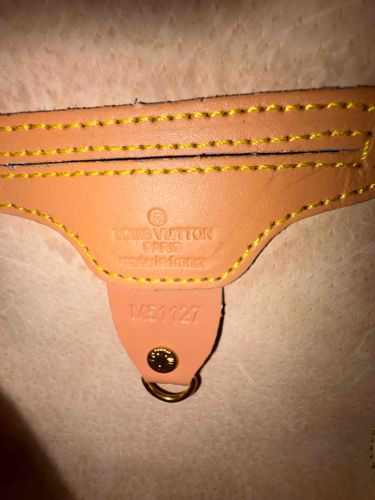
This item is a close-up image of a Louis Vuitton leather tag, likely found inside one of their handbags or luggage pieces. The tag is made of natural, untreated vachetta leather, which has developed a light honey-colored patina, indicating some use and exposure, but not significant darkening. The overall shape of the visible part of the tag is a curved rectangle at the top, transitioning into a pointed, more narrow section at the bottom, where a brass D-ring or O-ring is attached via a brass rivet. The leather is stitched with bright yellow contrasting thread around its perimeter, showing two lines of stitching at the top wider section and single lines along the curves and the pointed end. The stitching appears even and well-executed, indicative of quality craftsmanship.
Debossed into the leather at the wider top section are the brand markings: a circled 'R' for registered trademark, 'LOUIS VUITTON' in capital letters, 'PARIS', and 'made in france'. All text is clear and crisp, suggesting an authentic stamping. Below this, on the narrower, pointed section, a date code 'MS4127' is debossed. This code typically indicates the factory location and the week/year of manufacture for Louis Vuitton products. The brass rivet securing the ring bears the Louis Vuitton floral monogram logo, characteristic of authentic hardware. The leather shows very minor signs of wear, typical of a used item, but no significant damage, tears, or cracking. The patina is even, suggesting careful use. The craftsmanship appears to be of high quality, consistent with the luxury brand.
AI Appraisal Report
I have examined the provided image of the Louis Vuitton leather tag with date code 'MS4127'. Based on my visual assessment, the tag appears to be authentic. The vachetta leather shows a natural, light honey patina consistent with moderate use, and the debossed 'LOUIS VUITTON PARIS made in france' appears clear and crisp, as expected from genuine articles. The stitching is even and well-executed, as is the Louis Vuitton monogram on the brass rivet, all indicative of authentic craftsmanship.
This specific item is a component of a larger Louis Vuitton product, likely a handbag or piece of luggage. As such, its value is derived primarily from its status as a replacement part or a collector's curiosity rather than a standalone luxury item. The condition is very good, with only minor signs of wear and an even patina, which maintains its aesthetic appeal for such an accessory.
However, the market for individual leather tags, even authentic ones, is specialized and relatively small. Comparables would include other genuine Louis Vuitton replacement parts or tags sold individually, which typically fetch between $50 and $150 depending on condition and specific markings. Demand is primarily from collectors, restorers, or individuals seeking to authenticate or repair their own Louis Vuitton items. Rarity is low as these are standard components.
It is crucial to note the limitations of visual authentication from images alone. While all visible indicators suggest authenticity, a complete and definitive authentication would require physical examination to assess leather texture, smell, precise debossing depth, and the weight and feel of the hardware. Provenance documentation or a detailed inspection by a certified authenticator with specialized equipment would provide conclusive verification, especially to rule out high-quality replicas that may mimic visual cues.