AI estimate as of July 26, 2025 · verify with a professional before acting
AI-Generated · Verify before acting
Everything on this page is generated by AI for informational purposes only. AI can make mistakes — the AI may misidentify items or misattribute them (artist, maker, brand, designer, origin, era). This is not an official valuation and should not be used for insurance, sale, tax, estate, legal, or lending purposes — or any decision requiring a certified appraisal. It is not an authoritative claim about any person, brand, or rights holder — do not share or rely on it as a factual statement about a third party. Always consult qualified professionals before making financial decisions.
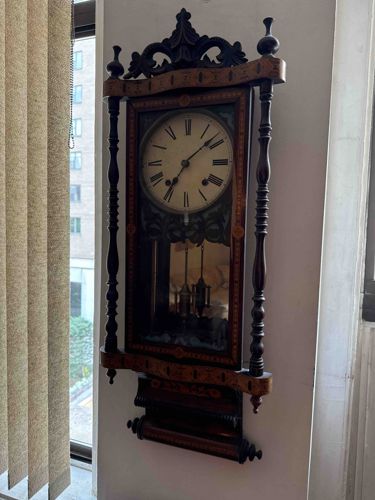
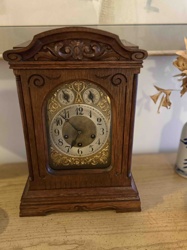
The item is an antique or vintage wall-mounted pendulum clock, likely a 'gingerbread' or 'kitchen' clock style, characterized by its ornate, decorative wooden case. The case appears to be constructed from dark-stained wood, possibly oak or walnut, featuring a rich, deep brown hue. It exhibits intricate carving and fretwork at the top, including a prominent central finial and two smaller, turned finials on either side, atop fluted posts. The main body of the clock is rectangular, housing a circular clock face with Roman numerals indicating the hours, and what appears to be a cream or off-white background with black hands. Below the clock face, the lower section of the case features a mirrored glass panel, which reflects the room, suggesting a standard pendulum movement would be visible behind it. The mirror itself has a painted or applied design at the top, possibly depicting a landscape or architectural scene, which has darkened with age. The case is further embellished with lighter-toned wood inlays or marquetry, visible as decorative banding above the clock face and along the base of the main rectangular section, providing a contrast to the darker wood. Both sides of the clock feature turned and fluted columns, adding to its architectural appearance. The bottom section of the clock has another decorative element; a horizontal wooden bar with two small turned finials extending outwards. The overall condition appears to be good for its age, with visible signs of wear consistent with an antique item, such as a slight darkening or fading of the wood's finish in some areas, and the mirror's image showing signs of age. No obvious major damage, cracks, or missing pieces are discernible. The craftsmanship suggests a period likely late 19th to early 20th century, given the prevalent style of ornamentation.
AI Appraisal Report
Based on my visual examination of the Ornate Antique Wall Clock, I assess its condition as good for its age, consistent with a late 19th to early 20th-century 'gingerbread' or 'kitchen' clock. The intricate carving, fretwork, and inlaid wood suggest skilled craftsmanship. There are no obvious signs of major damage, cracks, or missing pieces, though the darkening and fading of the wood's finish, and the aged appearance of the mirrored panel, are consistent with antique wear.
Authenticity, based solely on images, appears strong for an item of this period and style. However, a full authentication would require an in-person examination to inspect the movement's manufacturer marks, verify wood species, and closely examine the construction techniques. Provenance documentation, such as original sales receipts or family history, would significantly aid in establishing a more definitive history and authenticity. Scientific testing, such as dendrochronology for the wood, or carbon dating for internal components (if applicable), could provide further verification, although this is rarely done for items of this value range.
Market conditions for antique wall clocks of this type are generally stable, with consistent, albeit not explosive, demand among collectors of Americana and period furnishings. Comparable sales of similar ornate wall clocks in good working order typically fall within the identified range. Factors significantly impacting value include the clock's original manufacturer (e.g., Ansonia, Seth Thomas), the complexity of its movement, and its perfect working condition. Rarity is moderate; while ornate, these styles were produced in significant quantities. This specific piece's well-preserved aesthetic appeal enhances its desirability.
The primary limitation of this appraisal is the lack of physical inspection. I cannot confirm the operational status of the movement, the integrity of the internal components, or the presence of any repairs not visible externally. The mirrored panel's complete condition and the clarity of its painted scene also warrant in-person inspection.