AI estimate as of July 25, 2025 · verify with a professional before acting
AI-Generated · Verify before acting
Everything on this page is generated by AI for informational purposes only. AI can make mistakes — the AI may misidentify items or misattribute them (artist, maker, brand, designer, origin, era). This is not an official valuation and should not be used for insurance, sale, tax, estate, legal, or lending purposes — or any decision requiring a certified appraisal. It is not an authoritative claim about any person, brand, or rights holder — do not share or rely on it as a factual statement about a third party. Always consult qualified professionals before making financial decisions.
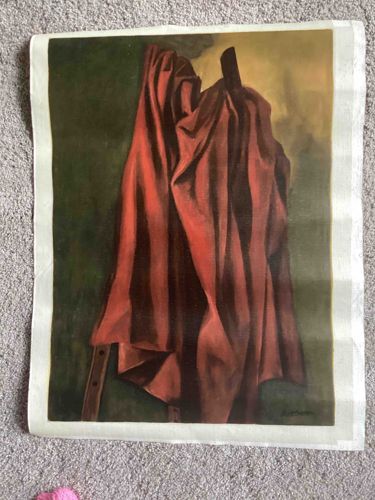
The item is an art print depicting a draped red fabric, likely a robe or cloak, against a dark, moody background transitioning from deep forest green on the left to a warm, ochre yellow on the right, suggesting a light source. The fabric itself is rendered with rich, deep reds and maroons, showcasing intricate folds and shadows that create a sense of depth and volume. The brushstrokes, though appearing flat due to the nature of a print, suggest an original oil painting with visible texture and layering in the color application. Notable features include the way the fabric appears to hang from a central, darker, possibly structural element at the top, and a strap or belt-like element with two visible buttons or studs hanging down on the lower left. The overall impression is one of classical drapery studies or perhaps a symbolic representation. There are no discernible maker's marks or signatures on the visible digital image, though a faint, dark signature or inscription can be seen in the lower right corner, which is too indistinct to read. The print itself appears to be on a paper or canvas-like material, possibly without a frame, and exhibits some slight curling along the edges, common for unframed prints. The white border surrounding the image suggests it was either printed with a margin or was matted. The style appears to lean towards academic realism or a more dramatic, possibly Romantic, approach to still life or figure studies, though without a figure, it acts more as a study of form and light on fabric. Its estimated age is difficult to determine without clearer identifying marks, but the subject matter and style could date it from the late 19th to mid-20th century. The quality of the print seems to capture the original artwork's details and color palette effectively.
AI Appraisal Report
Upon examining the provided image of the 'Draped Red Fabric Study Print,' I assess its condition as good for a print of its likely age, noting the slight curling edges consistent with an unframed piece, and the presence of a white border. Authenticity as an "art print" is visually confirmed; however, its authenticity as a print of a specific, identifiable artist's work is limited without a clear signature or provenance. The faint, indistinct mark in the lower right corner makes definitive artist attribution impossible from an image alone.
Market conditions for academic and classical study prints vary widely. While the artistic quality of the original work (implied by the print) appears strong, the lack of an identifiable artist or definitive medium ("print" vs. "reproduction") significantly impacts its marketability. Comparable items often include reproduction prints of classical studies or uncredited works, which typically fetch modest prices. Demand for unauthenticated prints, even of high-quality imagery, is generally low compared to authenticated, signed, or limited-edition works.
Factors significantly impacting value include the unreadability of the signature, the unknown provenance, and the fact that it is a print, not the original artwork. Its rarity is undetermined; it could be a unique artist proof or part of a larger, unnumbered edition.
For full authentication and a more precise valuation, an in-person examination is crucial. This would allow for inspection of print quality (e.g., halftone dots, paper type), direct examination of the faint signature under magnification, and assessment for any hidden marks or watermarks. Provenance documentation, such as records of sale or exhibition, would be invaluable. Scientific testing, like UV light examination for signature verification or paper analysis, could further aid in dating and attribution not possible from an image.