AI estimate as of October 14, 2025 · verify with a professional before acting
AI-Generated · Verify before acting
Everything on this page is generated by AI for informational purposes only. AI can make mistakes — the AI may misidentify items or misattribute them (artist, maker, brand, designer, origin, era). This is not an official valuation and should not be used for insurance, sale, tax, estate, legal, or lending purposes — or any decision requiring a certified appraisal. It is not an authoritative claim about any person, brand, or rights holder — do not share or rely on it as a factual statement about a third party. Always consult qualified professionals before making financial decisions.
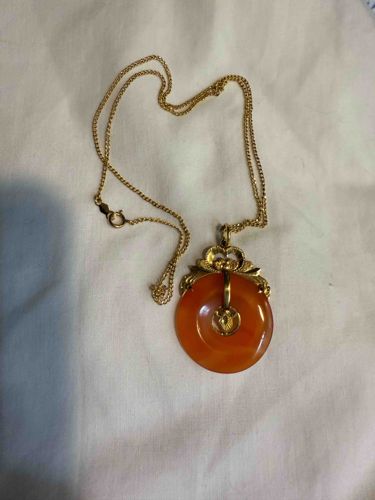
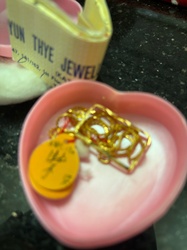
This item is a necklace featuring a gold-tone chain and a prominent orange disc pendant. The chain appears to be a delicate, possibly curb or rope style, with small links, uniformly colored in a bright gold tone, suggesting it could be gold-plated or a gold alloy. Its length is not precisely discernible but it is long enough to drape as a typical necklace. The chain connects to a spring ring clasp, also in gold tone, for securing the necklace around the neck. The main feature is the round, flat pendant, which is a rich, translucent orange color. This disc has a polished surface and a distinct, central circular opening, characteristic of a 'pi disc' or similar cultural motif. The material of the orange disc appears to be a type of natural stone, possibly carnelian or agate, given its color depth and slight variations in translucency. It is suspended from an ornate gold-tone bail that features decorative filigree or scrollwork, suggesting a somewhat ornate or perhaps vintage aesthetic. A smaller, decorative element, possibly a stylized heart or shield with an etched pattern, is affixed within the central opening of the orange disc and directly below the bail. The metal components, including the chain, bail, and central accent, all exhibit a consistent bright, shiny gold finish. No obvious signs of damage, significant wear, or repairs are visible from the image, but the gold tone's luster could indicate it is either newer, well-maintained, or not solid gold. The design suggests a style period from the mid to late 20th century, possibly the 1970s or 1980s, given the combination of natural stone and bright gold-tone metal. The craftsmanship of the metalwork, while decorative, appears to be industrially produced rather than handcrafted, though the stone itself may have been hand-cut and polished. There are no visible maker's marks or signatures.
AI Appraisal Report
Based on my visual examination of the provided image, this Gold-Tone Chain with Orange Disc Pendant appears to be in very good condition, showing no obvious signs of significant wear, damage, or repairs. The gold-tone components maintain a consistent bright luster, and the orange disc pendant is free from chips or cracks. Authenticity of materials, particularly the gold content and the specific identity of the orange stone, cannot be definitively verified from images alone. The gold tone suggests it is likely gold-plated or a gold alloy, rather than solid gold, a factor that significantly impacts value.
The translucent orange disc, possibly carnelian or agate, with its central opening, gives a nod to 'pi disc' designs, which adds a decorative appeal. The ornate bail and the small accent within the disc's opening enhance its aesthetic. The overall style, combining natural stone with bright gold-tone metal, points to a period likely between the 1970s and 1980s. While visually appealing, the craftsmanship suggests industrial production rather than highly skilled artisanal work, which limits its collectible value to some extent. There are no visible maker's marks, further hindering specific attribution.
In terms of market conditions, similar vintage gold-tone fashion jewelry with semi-precious or art glass stones typically falls into an accessible price range. Demand for such pieces is generally steady among costume jewelry collectors or those seeking vintage aesthetics, but it is not considered rare. Factors depressing value include the likely non-precious nature of the gold-tone metal and the absence of any signature or high-end craftsmanship. To fully authenticate the materials (e.g., specific stone identification, gold plating thickness or content) and verify potential vintage origin, an in-person examination, potentially including gemological testing and metal assay, would be required. Provenance documentation would also be crucial for any claims of designer origin or significant historical value.