These notes were written by the person who submitted this item. Appraiser.AI has not verified them, and the AI's identification and estimate may rely on them.
AI Estimated Value
Not an official valuation
$25-45
AI estimate as of November 5, 2025 · verify with a professional before acting
AI-Generated · Verify before acting
Everything on this page is generated by AI for informational purposes only. AI can make mistakes — the AI may misidentify items or misattribute them (artist, maker, brand, designer, origin, era). This is not an official valuation and should not be used for insurance, sale, tax, estate, legal, or lending purposes — or any decision requiring a certified appraisal. It is not an authoritative claim about any person, brand, or rights holder — do not share or rely on it as a factual statement about a third party. Always consult qualified professionals before making financial decisions.
This analysis also relies on unverified notes provided by the user, which may be incomplete or inaccurate and could affect the result.
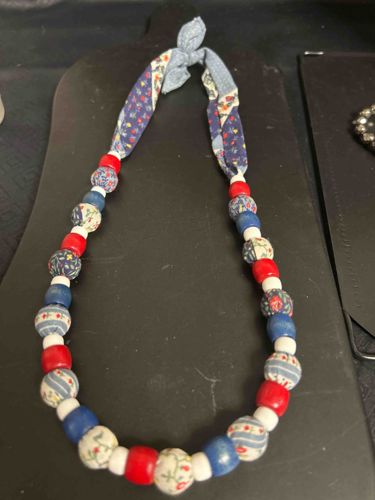
This is a whimsical folk art necklace constructed from a combination of fabric-covered beads, painted wooden beads, and a fabric tie closure. The necklace measures approximately 28 inches in length and weighs 59 grams, indicating a substantial but comfortable weight for wear. The beads are arranged in a repeating pattern of white, red, and blue, interspersed with fabric-covered beads featuring various floral and striped patterns, predominantly in shades of blue, red, and white. The fabric beads appear to be wrapped tightly around a core, possibly wooden or another lightweight material, and showcase small-scale floral motifs, stripes, and subtle geometric designs, giving them a whimsical, patchwork-like aesthetic. The white and red beads are uniformly painted, appearing to be solid wood, while the blue beads have a slightly textured, matte finish, also suggestive of painted wood. The construction method involves stringing these beads onto a cord, which then transitions into a braided or twisted fabric tie at the nape of the neck. This tie is made from a light blue denim-like fabric with small floral patterns and is knotted for closure, suggesting a somewhat rustic or handmade quality. There are no visible maker's marks or signatures, consistent with a handmade or folk art piece. The condition appears good with no obvious major damage, although some slight wear consistent with use might be present on the fabric or painted surfaces. This piece likely dates from the late 20th century or early 21st century, embodying a casual, bohemian, or Americana-inspired style. The craftsmanship, while not fine jewelry, shows care in the bead wrapping and assembly, indicating a piece made with an artisan touch.
AI Appraisal Report
Upon examining this folk art necklace, I've concluded it is a charming and well-executed piece of artisan craft jewelry. The construction, utilizing fabric-wrapped beads alongside painted wooden ones in a patriotic color scheme, is consistent with handmade items from the late 20th or early 21st century. The use of a fabric tie closure further supports its identity as a non-traditional, bohemian, or Americana-style accessory. The condition appears to be very good, with the fabric and painted surfaces showing minimal wear, indicating it has been well-cared for. There are no maker's marks, which is typical for this genre of jewelry.
The market for contemporary folk art or craft jewelry is primarily driven by aesthetic appeal and wearability rather than by collectible rarity or precious materials. Comparable handcrafted fabric and wood necklaces on platforms like Etsy or at craft fairs typically fall within a modest price range. The primary factors influencing its value are its visual charm, good condition, and the labor involved in its creation. Its lack of precious materials, a known artist signature, or significant age limits its value in the secondary market. The demand for such pieces is steady but dependent on current fashion trends favoring bohemian or handmade styles.
It is important to note that this appraisal is based on digital images and a provided description. While the piece appears authentic to its type, a definitive assessment of the materials (e.g., the type of wood or fabric) and construction techniques would require a physical, in-person examination. However, for a piece of this nature, extensive scientific testing is not necessary as its value is derived from its artisan qualities rather than its material composition.