AI estimate as of November 2, 2025 · verify with a professional before acting
AI-Generated · Verify before acting
Everything on this page is generated by AI for informational purposes only. AI can make mistakes — the AI may misidentify items or misattribute them (artist, maker, brand, designer, origin, era). This is not an official valuation and should not be used for insurance, sale, tax, estate, legal, or lending purposes — or any decision requiring a certified appraisal. It is not an authoritative claim about any person, brand, or rights holder — do not share or rely on it as a factual statement about a third party. Always consult qualified professionals before making financial decisions.
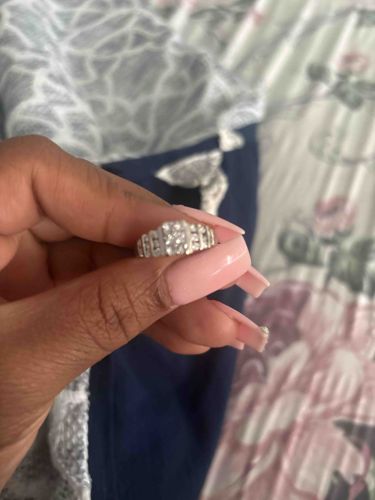
This item is a ring featuring a central cluster of square-cut stones, likely cubic zirconia or small diamonds, surrounded by multiple rows of smaller, round brilliant-cut stones. The metal appears to be a white metal, such as silver, white gold, or platinum, given its bright, reflective aesthetic. The overall design suggests a contemporary style, possibly from the late 20th or early 21st century. The central cluster is composed of four square-cut stones set closely together to form a larger square shape, giving the impression of a single, substantial stone. Flanking this central motif on both sides are three tiered rows of channel-set or pave-set smaller round stones, extending down the shoulders of the band. The band itself is sturdy and appears to have a polished finish, though the close-up image quality makes it difficult to discern fine details of the setting (e.g., prongs, bezel, channel integrity). There are no discernible maker's marks, signatures, or specific hallmarks visible in the provided image. The general condition appears good, with no obvious signs of significant wear, missing stones, or damage, though a clear assessment would require closer inspection. The stones exhibit good sparkle, suggesting they are either well-cut diamonds or high-quality diamond simulants. The craftsmanship appears to be of a reasonable standard for mass-produced fine or fashion jewelry.
AI Appraisal Report
Based on my visual examination of the provided image, this multi-stone 'diamond-look' ring presents as a contemporary piece, likely crafted from a white metal like sterling silver, possibly plated, or a low-karat white gold. The central cluster of four square-cut stones, designed to mimic a larger square diamond, suggests a good quality diamond stimulant such as cubic zirconia or moissanite. The surrounding smaller, round brilliant-cut stones set in tiered rows further enhance this 'diamond' aesthetic. The overall condition appears good, with no obvious signs of significant wear, damage, or missing stones from the image. The sparkle of the stones is notable, indicative of either well-cut simulants or very small, lower-grade diamonds.
Authenticity of materials cannot be definitively determined from an image alone. Without visible hallmarks, it's impossible to confirm the metal composition (e.g., silver, white gold, platinum) or to verify if the stones are genuine diamonds or high-quality simulants. The craftsmanship appears consistent with mass-produced fashion or demi-fine jewelry. Market demand for diamond-look jewelry is generally stable for affordable, attractive pieces. Comparables for similar sterling silver and cubic zirconia rings typically range from $50 to $200, depending on brand and stone quality. If the metal were confirmed as 10k or 14k white gold and stones as genuine, albeit small, diamonds, the value would significantly increase. However, given the visual evidence alone, an appraisal of $75 - $175 is appropriate for a high-quality costume or demi-fine piece.
To ascertain full authenticity and precise material composition, an in-person examination is crucial. This would involve specific gravity tests and acid tests for metal verification, and a gemological examination (e.g., thermal conductivity testing, magnification) to differentiate between diamonds and simulants. The absence of visible hallmarks further necessitates physical inspection for a conclusive appraisal.