AI estimate as of July 6, 2025 · verify with a professional before acting
AI-Generated · Verify before acting
Everything on this page is generated by AI for informational purposes only. AI can make mistakes — the AI may misidentify items or misattribute them (artist, maker, brand, designer, origin, era). This is not an official valuation and should not be used for insurance, sale, tax, estate, legal, or lending purposes — or any decision requiring a certified appraisal. It is not an authoritative claim about any person, brand, or rights holder — do not share or rely on it as a factual statement about a third party. Always consult qualified professionals before making financial decisions.
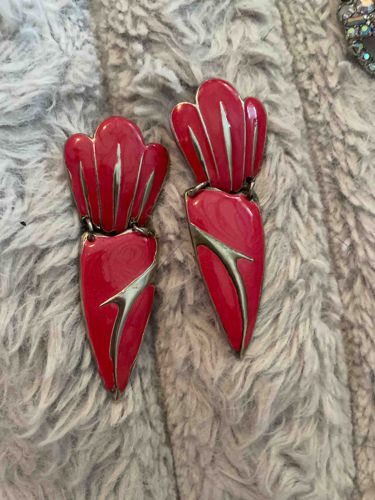
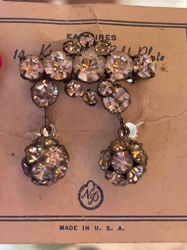
This appears to be a pair of vintage, possibly Art Deco, clip-on earrings, or decorative dress clips, featuring a striking red enamel and silver-toned metal design. Each piece is composed of two distinct sections: an upper, fan-like or scalloped motif, and a lower, elongated, tapering drop. The red enamel displays a vibrant, semi-glossy finish, indicating it could be a type of baked enamel or a resin. The silver-toned metal provides a strong contrast, forming decorative lines and borders throughout the design. In the upper section, the metal creates vertical stripes, enhancing the fan-like appearance, while in the lower section, it forms an abstract, flowing 'S' or swirling pattern, adding dynamic movement. The construction suggests that the two sections are articulated, likely connected by a hinge or simple ring, allowing for some movement. The overall design evokes a stylized floral or shell motif, but with a highly geometric and streamlined aesthetic common to the Art Deco period (1920s-1930s). There are no visible maker's marks or signatures from this image alone. The condition appears good, with some potential minor wear to the enamel or metal consistent with age and use, but no significant chipping or damage is immediately apparent. The surfaces show some light reflections, indicating the smoothness of the enamel. These pieces showcase a distinct period style with good craftsmanship in their intricate enameling and metalwork, making them a decorative and collectible item.
AI Appraisal Report
Based on my visual examination of the provided image, this pair of vintage red enamel and silver-toned articulated clips presents as a charming example of period jewelry, likely from the Art Deco era (1920s-1930s).
Condition and Authenticity: The vibrant red enamel appears to be in good condition with a semi-glossy finish, consistent with a baked enamel or quality resin. While reflections suggest smoothness, a physical examination would be needed to confirm no hairline cracks or chips are present, and to assess the integrity of the enamel's adherence to the metal. The silver-toned metal shows good contrast and forms clear decorative patterns; I would inspect for tarnishing, pitting, or plating loss in person. The articulated nature suggests a hinge or simple ring connection, which would need to be checked for wear or looseness. Given the visual style, the pieces appear authentic to the period represented, but without maker's marks or provenance, attributing them definitively to a specific designer or workshop is impossible.
Market Conditions & Comparables: Vintage Art Deco-inspired clips or earrings, especially those with striking color and geometric design, generally have a steady collector market. Comparables for unsigned, good condition pieces of this nature typically fall into the lower-to-mid range of vintage costume jewelry. The 'S' or swirling pattern and fan motif are attractive elements that enhance aesthetic appeal.
Demand & Rarity: There is consistent demand for authentic Art Deco 'look' pieces. While not extremely rare without a known maker, the good condition and vibrant enamel make these desirable. Rarity would significantly increase with a prominent designer attribution.
Factors Impacting Value: Key factors include the actual composition of the silver-toned metal (is it sterling, silver plate, or base metal?), the type of enamel (vitreous enamel vs. cold enamel/resin), and the presence or absence of maker's marks.
Limitations: My assessment of authenticity is based solely on visual style. A physical inspection would allow me to determine the metal's composition (e.g., using a non-destructive XRF test if necessary), confirm the type of enamel, and thoroughly assess overall structural integrity and hidden wear. Provenance documentation, if available, would significantly aid in full authentication and value assessment.