AI Appraisal Estimate

AI-generated estimates · not official valuations

From the user

What was submitted

Photo and notes provided by the user — not generated by AI

Submitted item photo
Submitted photo · June 6, 2026

User's notes

No additional notes provided.

AI analysis below

AI appraisal

AI analysis & estimate

AI-Generated · Verify before acting

Everything below is generated by AI for informational purposes only. AI can make mistakes — the AI may misidentify items or misattribute them (artist, maker, brand, designer, origin, era). This is not an official valuation and should not be used for insurance, sale, tax, estate, legal, or lending purposes — or any decision requiring a certified appraisal. It is not an authoritative claim about any person, brand, or rights holder — do not share or rely on it as a factual statement about a third party. Always consult qualified professionals before making financial decisions.

Read the full disclaimer

AI Identification

·Not independently authenticated·Verify before acting

Antique Baby Rattle in Glass Cloche Display

Antique Baby Item / Collectible Display

AI Estimated Value

·Not an official valuation·Verify before acting

$250-400

As of June 6, 2026

AI Item Analysis

·AI can make mistakes·Verify before acting
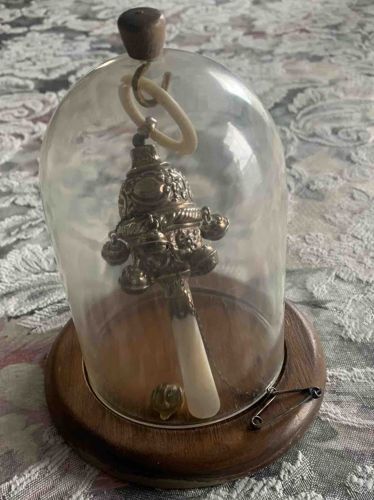
The item depicted is an antique silver-plated or Britannia metal baby rattle, likely from the Victorian or Edwardian era, displayed within a glass cloche on a wooden base. The rattle features a handle made of a light-colored material, possibly bone or ivory, which tapers from a narrow end to a wider base. The metal portion of the rattle is ornately decorated with repoussé or chased patterns, including floral motifs and what appear to be figural elements or possibly architectural details. Several small bells are suspended around the central body of the rattle, suggesting its function as a noise-making toy for infants. The metal has developed a dark, uneven patina, indicating its age and the oxidation of the metal, possibly with some areas of tarnish. The glass cloche is clear and bell-shaped, with a small wooden knob at its apex, from which a light-colored ring, possibly bone or ivory, is suspended by a metal hook. The hook holds the rattle, allowing it to hang freely within the cloche, showcasing it as a decorative or sentimental object. The wooden base is circular, with a raised rim that seats the cloche, and exhibits a rich, warm brown tone consistent with polished wood. The overall craftsmanship suggests a mass-produced item characteristic of the late 19th or early 20th century, though the individual decorative elements show a decent level of detail. The display setup itself is well-preserved, with the glass and wood appearing to be in good condition. There are two safety pins visible on the wooden base outside the cloche, which are modern additions and not part of the rattle assembly.
AI Appraisal Report

·AI can make mistakes·Verify before acting
Upon examining the provided image of the antique baby rattle in a glass cloche display, I assess the item to be a charming example of late Victorian or Edwardian children's collectibles. The rattle itself appears to be silver-plated or Britannia metal, exhibiting typical repoussé or chased floral and figural decoration from the period. The handle is likely bone or ivorine, common materials for such items. Its dark, uneven patina strongly suggests age and genuine oxidation rather than artificial aging. The overall condition of the rattle, despite the tarnish, appears good, with no obvious signs of significant damage or missing bells. The display cloche and wooden base are in remarkably good condition, showcasing the rattle effectively. The presence of the original hanging mechanism within the cloche adds to its integrity as a display piece. The two modern safety pins on the base are external and do not detract from the item's historical value. From a market perspective, antique baby rattles are moderately sought after, especially those with intricate designs and in good condition. The cloche display enhances its appeal, elevating it from a simple collectible to a decorative object. Comparables typically range from utilitarian brass or plated rattles to more valuable sterling silver examples. This particular piece falls somewhere in the middle. Demand is steady among collectors of juvenilia, Victoriana, and decorative arts. Rarity is moderate; while such rattles were mass-produced, well-preserved examples in their original display settings are less common. Factors significantly impacting value include the material of the rattle (sterling silver would command a much higher price), the authenticity of the handle material (real ivory vs. bone/ivorine), and the overall condition of both the rattle and the cloche. The display significantly adds to its marketability. Limitations in authenticity verification from images alone include definitively determining the metal composition (e.g., sterling silver vs. plated) and the exact material of the handle (bone, ivory, or early plastic composite). A physical in-person examination would allow for closer inspection of hallmarks, if any, and tactile assessment of materials. Scientific testing (e.g., specific gravity or spectroscopy for material identification) or clear provenance documentation would be needed for absolute authentication of higher-value materials like ivory or sterling silver.

Get your items appraised

Instant estimates of your treasures with AI-powered appraisals

Browse More Appraisals