Photo and notes provided by the user — not generated by AI
Submitted photo · June 6, 2026
User's notes
No additional notes provided.
AI analysis below
AI appraisal
AI analysis & estimate
AI-Generated · Verify before acting
Everything below is generated by AI for informational purposes only. AI can make mistakes — the AI may misidentify items or misattribute them (artist, maker, brand, designer, origin, era). This is not an official valuation and should not be used for insurance, sale, tax, estate, legal, or lending purposes — or any decision requiring a certified appraisal. It is not an authoritative claim about any person, brand, or rights holder — do not share or rely on it as a factual statement about a third party. Always consult qualified professionals before making financial decisions.
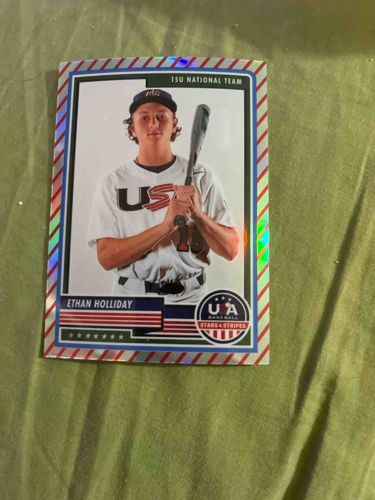
This item is a modern sports trading card, specifically a baseball card featuring an athlete identified as Ethan Holliday. The card exhibits a rectangular shape, typical of standard trading card dimensions, and is made from a glossy cardstock material. The primary image on the card features Ethan Holliday in a white baseball uniform with the letters "USA" prominently displayed on the front. He is wearing a dark baseball cap and holding a bat. Above his head, the text "15U NATIONAL TEAM" is visible, indicating his affiliation. The card has a distinctive border design: a white inner border, followed by a thin blue border, and then a wider, iridescent or holographic outer border with diagonal stripes in red, silver, and blue, creating a rainbow foil effect when light reflects off it. This holographic effect suggests a parallel or insert card, often rarer than base cards. At the bottom left, "ETHAN HOLLIDAY" is printed. Below his name, there's a design element resembling a portion of the American flag with red and white stripes and a field of blue with white stars. To the right of the flag design, there is a circular logo that reads "USA BASEBALL STARS & STRIPES", likely signifying the card's series or collection. The card appears to be in very good to excellent condition, with no visible creases, surface scratches, or significant edge wear from the image provided. The colors are vibrant and the print quality appears sharp. The craftsmanship is consistent with mass-produced trading cards using modern printing techniques, with the holographic element indicating a higher-tier production run.
AI Appraisal Report
·AI can make mistakes·Verify before acting
Upon examining the provided image of the Ethan Holliday 15U National Team USA Baseball Stars & Stripes Holographic Parallel Sports Trading Card, I assess its condition as very good to excellent. The card appears sharp, vibrant, and free from visible creases, significant surface scratches, or edge wear. This strong visual condition is crucial for value in the trading card market. Authenticity, based solely on the image, seems high for a mass-produced item of this nature, consistent with Topps or Panini releases. However, without physical examination, I cannot verify print defects, surface indents, or the true integrity of the holographic foil.
Market conditions for current baseball prospects like Ethan Holliday are dynamic, heavily influenced by their performance and projected MLB draft status. This "Stars & Stripes" holographic parallel is a desirable card, generally rarer than base versions due to its parallel nature and the attractive 'rainbow foil' effect. Demand for Holliday's cards is driven by his status as a top prospect. Comparable sales for similar holographic/foil parallels of other high-ranking amateur/prospect players from USA Baseball sets typically vary widely based on player hype and specific rarity (e.g., numbered vs. unnumbered).
Factors significantly impacting this card's value include its excellent apparent condition, the visual appeal of the holographic parallel, and Ethan Holliday's continued success in his baseball career. Should he reach the MLB and perform well, the value could appreciate significantly. Conversely, a decline in prospect status would negatively impact value.
Limitations in authenticity verification from images alone are inherent. A full authentication would require in-person examination to check for subtle alterations, verify card stock, and inspect the true surface integrity and print quality under magnification. While not typically needed for trading cards of this type, provenance documentation (e.g., original packaging, purchase receipts) could further strengthen its legitimacy. Scientific testing, like spectral analysis, is generally reserved for high-value, high-risk items and not common for modern trading cards unless counterfeiting is strongly suspected.