AI estimate as of October 18, 2025 · verify with a professional before acting
AI-Generated · Verify before acting
Everything on this page is generated by AI for informational purposes only. AI can make mistakes — the AI may misidentify items or misattribute them (artist, maker, brand, designer, origin, era). This is not an official valuation and should not be used for insurance, sale, tax, estate, legal, or lending purposes — or any decision requiring a certified appraisal. It is not an authoritative claim about any person, brand, or rights holder — do not share or rely on it as a factual statement about a third party. Always consult qualified professionals before making financial decisions.
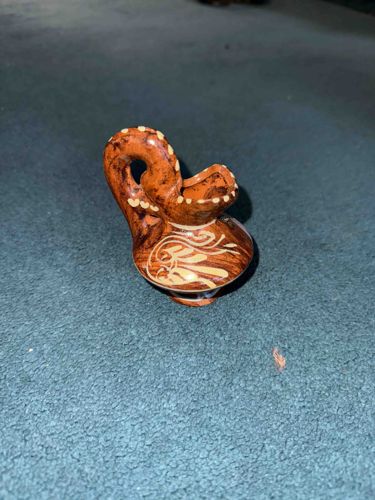
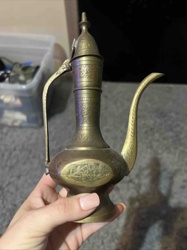
This appears to be a small, decorative ceramic object, possibly an oil lamp or simply an ornamental piece. Its primary color is a rich, reddish-brown, reminiscent of terra cotta or dark earthenware, with a slightly glossy finish that may indicate a glaze. The surface features a distinctive swirling or wood-grain-like pattern in varying shades of brown, adding textural visual interest. Embellishing this base color are intricate designs in a lighter, creamy off-white or pale beige color. These designs consist of swirling floral or foliate motifs on the lower, wider body of the object, and a series of small, raised dots that outline the curved neck and spout-like protrusion. The object has a squat, round base that tapers upwards, forming a bulbous body, from which a graceful, S-shaped neck or handle emerges. At the end of this neck, there's an opening that resembles a spout or a wick holder, suggesting its potential function as an oil lamp, though it could also be purely decorative. There is a small, curved handle-like element on the opposite side of the spout. The craftsmanship appears to be handmade, indicated by the organic curves and the slightly irregular application of the decorative dots. No visible condition issues such as chips, cracks, or repairs are apparent from the provided image. The style suggests it could be an ethnic or artisanal piece, possibly from the mid to late 20th century. The quality indicators point to a handcrafted item, likely made for decorative purposes or as a small functional item.
AI Appraisal Report
Based on my visual examination of the provided image, this small ceramic object presents as either an oil lamp or an ornamental piece. Its reddish-brown, possibly terra cotta or earthenware body with a subtly glossy glaze, is adorned with striking swirling patterns and intricate off-white floral motifs and raised dots, outlining its elegant, S-shaped neck and handle. The craftsmanship appears artisanal, suggesting a handmade origin, likely from the mid to late 20th century. I observe no obvious condition issues like chips, cracks, or repairs from the image, which is a positive factor for its value. This apparent excellent condition is crucial for decorative ceramic items.
Market comparables for similar handcrafted or ethnic-style ceramic lamps and decorative objects from this period typically fetch modest prices. Without known provenance or a distinctive artist's signature, these items often fall into the decorative arts category rather than fine art. Demand for such pieces is generally stable, driven by individuals seeking unique artisanal home decor rather than collectors of specific historical artifacts. While charming, the item's perceived rarity is low, as many similar decorative ceramic items were produced during the mid to late 20th century.
Factors significantly impacting its value include its excellent apparent condition and appealing aesthetic. However, the lack of definitive origin, artist, or historical significance limits its upper market value. To fully authenticate its age, origin, and potential function as an oil lamp, an in-person examination would be essential. This would allow for a tactile assessment of the glaze, a closer inspection for any maker's marks, and a thorough check for internal residue if it was indeed used as a lamp. Scientific dating methods could provide precise age verification, and extensive provenance documentation would be needed to connect it to a specific culture or artisan. These limitations prevent a higher valuation based solely on the image.