AI estimate as of November 2, 2025 · verify with a professional before acting
AI-Generated · Verify before acting
Everything on this page is generated by AI for informational purposes only. AI can make mistakes — the AI may misidentify items or misattribute them (artist, maker, brand, designer, origin, era). This is not an official valuation and should not be used for insurance, sale, tax, estate, legal, or lending purposes — or any decision requiring a certified appraisal. It is not an authoritative claim about any person, brand, or rights holder — do not share or rely on it as a factual statement about a third party. Always consult qualified professionals before making financial decisions.
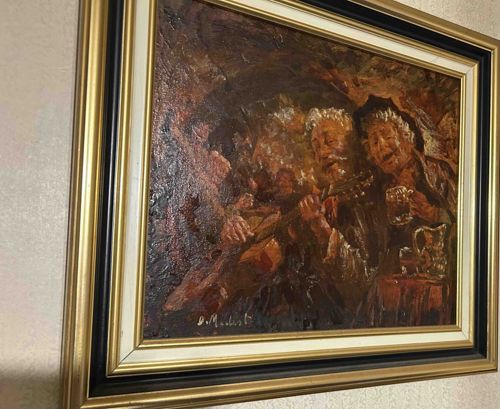
This item is an oil painting depicting a lively tavern or pub scene, rendered in a style reminiscent of 17th-century Dutch or Flemish genre painting, though likely a more contemporary interpretation. The painting captures a group of figures, likely men, engaged in revelry. Two figures are prominently featured on the right side: one with a white or grey beard and hat, holding what appears to be a stringed instrument (possibly a lute or mandolin), and another figure with a similar complexion, holding a stein or mug, seemingly laughing or singing. Another figure is partially visible on the left, also appearing to play an instrument. The color palette is rich and earthy, dominated by warm browns, reds, and ochres, with highlights of white or grey effectively depicting the figures' hair and some details. The brushstrokes are visibly thick and impasto, creating texture and a sense of movement and energy within the scene. The overall lighting is dim and atmospheric, suggesting an indoor evening setting illuminated by an unseen light source. A signature, which appears to read "D. M. Chot" or similar, is visible in the lower left corner of the painting. The painting is housed in an elaborate, multi-layered frame. The innermost layer is a cream or off-white liner, followed by a flat black border, and finally, a wide outer frame with a gold-leafed or gilded finish, featuring a classic stepped or rounded profile. There are no visible signs of significant damage to the painting itself from the provided image, such as tears, major cracks, or extensive paint loss, though the overall dark tonality and resolution make fine detail assessment challenging. The frame appears to be in good condition with no obvious nicks or major wear. The style suggests an appreciation for historical genre scenes, often appealing to collectors who enjoy traditional or classical art subjects. The craftsmanship of both the painting and its framing indicate a thoughtful presentation.
AI Appraisal Report
I have examined the provided image of this oil painting, depicting a 'Merry Companions' or 'Tavern Scene,' reminiscent of 17th-century Dutch/Flemish genre painting. Based on visual assessment, the condition of the painting appears good; no significant tears, cracks, or paint loss are discernible, though the dark tonality and image resolution limit a thorough inspection of fine details. The elaborate, multi-layered frame also appears to be in good condition.
The style suggests a contemporary interpretation rather than an authentic 17th-century work. The visible impasto brushwork, warm earthy palette, and thematic content are characteristic elements often found in decorative art or works by trained artists drawing inspiration from historical genres. The signature 'D. M. Chot' or similar, in the lower left, suggests an identified artist, which is a positive factor. However, without further information, establishing the artist's recognition or market history is impossible.
Market conditions for such genre scenes are steady, often appealing to collectors seeking traditional aesthetic decor. While not rare, well-executed examples maintain a consistent demand. The primary factors impacting value include the artist's identity and provenance. Without an established artist or provenance, the work’s value is driven more by its decorative appeal and execution quality.
Limitations: My authenticity verification is severely limited without a physical examination. I cannot definitively confirm its age, the artist's full name, or the originality of the work. An in-person inspection would allow for detailed examination of the paint layers, canvas, stretcher, and frame construction to better ascertain age and condition. Provenance documentation (exhibition history, sales records) and possibly forensic art analysis (pigment analysis, UV light examination) would be crucial for a full authentication and to establish the artist's complete identity and market standing.