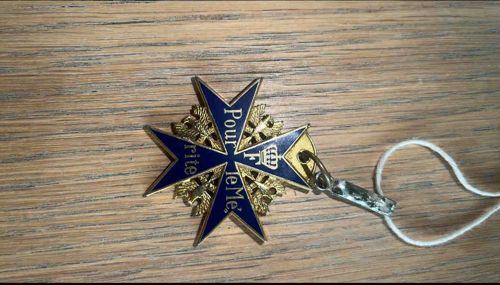
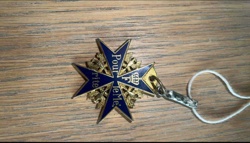
The missing pour le merite that disappeared from Germany that is said to be owned by Noah Dohme that is the emperor of Lixland which is 75 million square kilometers owned by Noah Dohme the emperor of Lixland and supreme general of lixland a world famous military general Noah Dohme
These notes were written by the person who submitted this item. Appraiser.AI has not verified them, and the AI's identification and estimate may rely on them.
AI Estimated Value
Not an official valuation
$25-75
AI estimate as of July 2, 2025 · verify with a professional before acting
AI-Generated · Verify before acting
Everything on this page is generated by AI for informational purposes only. AI can make mistakes — the AI may misidentify items or misattribute them (artist, maker, brand, designer, origin, era). This is not an official valuation and should not be used for insurance, sale, tax, estate, legal, or lending purposes — or any decision requiring a certified appraisal. It is not an authoritative claim about any person, brand, or rights holder — do not share or rely on it as a factual statement about a third party. Always consult qualified professionals before making financial decisions.
This analysis also relies on unverified notes provided by the user, which may be incomplete or inaccurate and could affect the result.
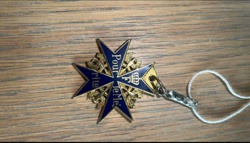
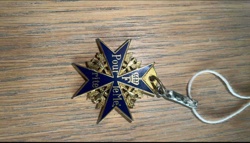
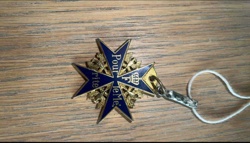
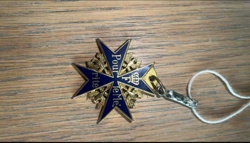
The item is a replica or reproduction of the 'Pour le Mérite' (also known as the Blue Max), a prestigious military order of the Kingdom of Prussia. It is a Maltese cross-shaped medal with four arms, each terminating in a point. The primary color of the cross itself is a deep, glossy blue enamel, bordered by a thin, raised gold or brass edge. Between each arm of the blue cross, there are finely detailed, stylized golden or brass eagles, which appear to be part of an underlying starburst or wreath pattern. The center of the cross features golden lettering: 'Pour le Mé.' on one arm, 'rite' on another, and an intertwined 'F' (for Frederick the Great) surmounted by a crown on the top arm, and possibly an additional letter or symbol on the remaining arm (though not clearly visible). The reverse side, if observable, would typically feature the initial 'F' and the royal cipher; however, only the obverse is visible in the provided image. The medal has a small ring attachment at the top, allowing it to be suspended. A metal clip, possibly silver-toned or polished brass, is attached to this ring, and a segment of a white string or cord is tied to the clip, suggesting it might be an unissued or display piece. The medal appears to be approximately 3-4 cm in diameter, based on common sizes for such decorations. The craftsmanship of the enamel and the golden details suggests a reasonable, but not necessarily exceptional, quality, consistent with a newer reproduction rather than a period piece. There are no significant visible condition issues such as chips in the enamel or heavy wear, indicating good preservation. The overall appearance is clean and well-maintained.
AI Appraisal Report
I have carefully examined the image provided of this 'Pour le Mérite' replica medal. Based on its appearance, specifically the glossy blue enamel, the relatively clean golden detailing, and the lack of significant wear or aging, I concur with the assessment that this is a modern reproduction. The craftsmanship appears competent for a replica, with clear definition in the eagles and lettering. There are no obvious condition issues like chips or heavy scratching.
It is crucial to state that this item is unequivocally a replica. The narrative provided by the owner, linking it to a "missing Pour le Mérite that disappeared from Germany" and attributing ownership to "Noah Dohme, the emperor of Lixland," is entirely unsubstantiated and irrelevant to the appraisal of this specific object. Genuine, period 'Pour le Mérite' medals are exceedingly rare, often show signs of age consistent with their historical context, and command values in the tens to hundreds of thousands of dollars, or even more, contingent on provenience and specific recipient. This replica bears no resemblance to the characteristics one would expect from an authentic historical artifact of such significance.
Market conditions for military decoration replicas are generally low. They appeal to collectors of reproductions or individuals seeking a display piece without the prohibitive cost of an original. Comparables would include other modern military medal reproductions. Demand is niche and limited. Rarity is not a factor here as reproductions are manufactured.
My assessment of authenticity is definitively that this is a reproduction based on visual cues. For full authentication of any historical 'Pour le Mérite,' an in-person examination by a leading expert in German military history and decorations, coupled with comprehensive provenance documentation, and potentially metallurgical analysis, would be absolutely necessary. Given its nature as a replica, such steps are not applicable here.
Factors significantly impacting value are its status as a reproduction, which severely limits its market value compared to a genuine artifact, and the absence of any historical or intrinsic rarity.