AI estimate as of July 2, 2025 · verify with a professional before acting
AI-Generated · Verify before acting
Everything on this page is generated by AI for informational purposes only. AI can make mistakes — the AI may misidentify items or misattribute them (artist, maker, brand, designer, origin, era). This is not an official valuation and should not be used for insurance, sale, tax, estate, legal, or lending purposes — or any decision requiring a certified appraisal. It is not an authoritative claim about any person, brand, or rights holder — do not share or rely on it as a factual statement about a third party. Always consult qualified professionals before making financial decisions.
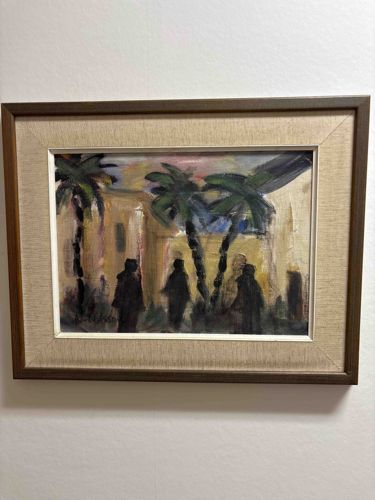
This item is a framed oil painting or acrylic painting on canvas or board, depicting a stylized outdoor scene with prominent palm trees and silhouetted figures. The overall dimensions appear to be approximately 24-30 inches in width and 18-24 inches in height, based on its context within the room. The painting employs a broad, impasto brushstroke technique, giving it a textured surface. The color palette is muted, featuring dark greens for the palm fronds, dark grays/blacks for the figures and tree trunks, and soft yellows, oranges, blues, and browns for the background sky and buildings. A notable feature is the abstracting of human figures into anonymous, dark silhouettes, suggesting a focus on atmosphere and light rather than individual identity. The buildings in the background are rendered with minimal detail, serving as a backdrop to the natural and human elements. The frame is a multi-part construction, consisting of an inner linen or fabric-wrapped mat in a light, neutral beige color, and an outer dark brown, possibly wooden, frame with a simple, flat profile. The corners of the outer frame appear to be mitered and tightly joined, indicating decent craftsmanship. There are no obvious signs of significant damage, such as cracks, tears, or major paint loss, but the resolution of the image does not permit a close inspection for minor abrasions or dust. The artwork itself has an impressionistic or expressionistic style, suggesting it might date from the mid to late 20th century. No visible artist's signature or maker's marks are discernible from the provided image.
AI Appraisal Report
Based on my visual examination of the provided image, this framed artwork, an Impressionistic Palm Tree Scene, appears to be in good overall condition. I could discern no obvious signs of significant damage such as tears, cracks, or major paint loss. The framing, with its inner linen mat and dark wooden outer frame, seems well-constructed with tight mitered corners. However, a definitive assessment of minor abrasions, surface dust, or subtle paint defects would require an in-person physical inspection.
From the image alone, authenticity cannot be definitively verified. The absence of a visible artist's signature or maker's mark limits verification. To fully authenticate, I would need a direct physical examination to look for hidden signatures, examine pigment and canvas/board aging, assess the exact medium (oil vs. acrylic), and potentially conduct scientific testing such as UV light examination for repairs or forgeries, or microscopic analysis of paint layers. Provenance documentation, such as purchase receipts, exhibition history, or artist's records, would be crucial for establishing its history and authorship.
Regarding market conditions, Impressionistic or Expressionistic landscape paintings, particularly those with a tropical subject and broad brushwork, generally maintain consistent demand in the secondary art market. The stylized, somewhat abstract nature of the figures and buildings suggests a mid-to-late 20th-century origin. While not unique, the technique and subject matter are appealing. The painting's value is primarily driven by its aesthetic appeal, condition, and decorative quality, given the lack of an identifiable artist or provenance. Without an attributed artist or significant historical context, it falls into the decorative art category.
Factors significantly impacting its value include its good apparent condition, attractive subject matter, and functional framing. The primary limitation is the lack of artist attribution, which prevents it from commanding higher prices associated with recognized artists. Rarity is difficult to determine without knowledge of the artist's output. Comparables would be similar size, unsigned, well-preserved mid-century landscape paintings sold through regional galleries or online art marketplaces.
Given these considerations, particularly the lack of artist identification and the visual limitations of image-only appraisal, I appraise this artwork as a decorative piece.