AI estimate as of October 9, 2025 · verify with a professional before acting
AI-Generated · Verify before acting
Everything on this page is generated by AI for informational purposes only. AI can make mistakes — the AI may misidentify items or misattribute them (artist, maker, brand, designer, origin, era). This is not an official valuation and should not be used for insurance, sale, tax, estate, legal, or lending purposes — or any decision requiring a certified appraisal. It is not an authoritative claim about any person, brand, or rights holder — do not share or rely on it as a factual statement about a third party. Always consult qualified professionals before making financial decisions.
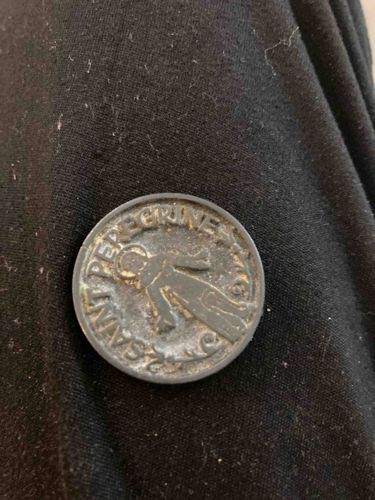
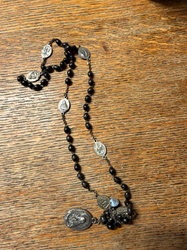
The item is a round religious medal, likely made of a base metal such as lead, pewter, or a similar alloy, given its aged and somewhat degraded appearance. Its diameter appears to be roughly the size of a modern coin, perhaps between 2.5 and 3.5 centimeters. The color is a muted, dark grayish-silver with visible areas of corrosion and discoloration, suggesting significant age or exposure to elements. The medal features raised, sculpted elements on its visible side. The central motif depicts a figure, possibly St. Peregrine, with arms outstretched or in a position of suffering, although extreme wear makes precise identification challenging. Surrounding the central figure is an inscription along the perimeter, partially legible as 'SAINT PEREGRINE'. The letters are in a sans-serif or block-style font, embossed and showing significant wear, particularly on the lower left and upper right sections. The surface is uneven, with a crusty texture in places due to oxidation and grime accumulation. There are no clear maker's marks or signatures visible. The edges of the medal are rough and worn, indicating handling and perhaps some damage over time. The overall condition suggests it is an older piece, possibly from the mid-20th century or earlier, and has a strong vintage or antique aesthetic due to its heavy patina and surface imperfections. The craftsmanship, while once likely clear, is now obscured by wear, but the raised design indicates a casting or stamping process. This type of medal is typically used for personal devotion or as a protective amulet within the Catholic tradition.
AI Appraisal Report
Based on my visual examination of the provided image of the St. Peregrine Religious Medal, I assess its condition as poor to fair. The significant wear, corrosion, and discoloration strongly suggest a base metal construction, likely lead or pewter, rather than precious metals. While the inscription 'SAINT PEREGRINE' is partially legible, the central figure is heavily obscured, making precise identification of iconographic details challenging. The craftsmanship appears to be a standard casting or stamping process common for devotional medals.
Authenticity: Without physical inspection, definitively confirming authenticity, especially regarding its precise age or origin, is impossible. While consistent with vintage or antique religious medals, such items are not typically subject to extensive counterfeiting. My assessment of authenticity is based solely on visual consistency with known examples of such medals.
Market Conditions & Comparables: This type of medal is common in the religious artifact market. Comparables for heavily worn, base-metal devotional medals typically range from a few dollars to twenty dollars. Demand is generally niche, appealing primarily to collectors of religious iconography or individuals seeking a devotional item. Rarity is low; St. Peregrine medals, while specific, are not exceptionally scarce.
Factors Impacting Value: The primary factors significantly impacting its low value are the material (base metal), the heavily worn condition, and the lack of rarity. The obscured imagery and general degradation detract from its aesthetic and collector appeal. Factors that *would* increase value, such as precious metal content, exceptional artistry, clear maker's marks, or documented provenance, are absent.
Limitations: For a full authentication and more precise dating, an in-person examination would be crucial. This would allow for tactile assessment of material, microscopic examination of wear patterns, and potential chemical analysis of the metal composition. Provenance documentation, such as a family history or acquisition records, would also provide invaluable context, which is currently lacking.