AI estimate as of July 30, 2025 · verify with a professional before acting
AI-Generated · Verify before acting
Everything on this page is generated by AI for informational purposes only. AI can make mistakes — the AI may misidentify items or misattribute them (artist, maker, brand, designer, origin, era). This is not an official valuation and should not be used for insurance, sale, tax, estate, legal, or lending purposes — or any decision requiring a certified appraisal. It is not an authoritative claim about any person, brand, or rights holder — do not share or rely on it as a factual statement about a third party. Always consult qualified professionals before making financial decisions.
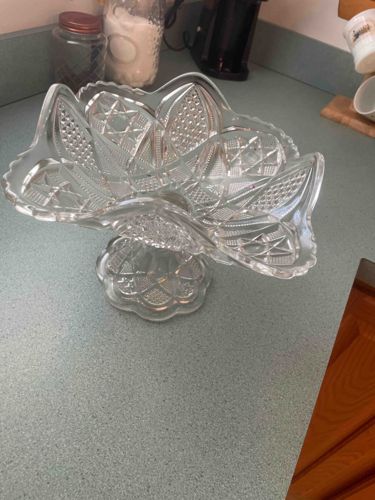
This is a clear glass footed compote dish, also commonly referred to as a candy dish or fruit bowl, featuring a distinctive pressed glass pattern. The dish consists of two main parts: a decorative bowl and a pedestal base, both crafted from clear, colorless glass. The bowl is shaped with six scalloped or petaled sections, each defined by prominent ridges and ornate pressed patterns. These patterns include a combination of cross-hatching, diamond motifs, and starburst designs, which catch and refract light effectively. The rim of the bowl follows the scalloped shape, adding to its visual appeal. The pedestal base is relatively short and wide, with a fluted or scalloped edge that mirrors the upper bowl's design. The base also features complementary pressed glass patterns, consistent with the overall aesthetic. The construction indicates it was likely made using a mold, characteristic of pressed glass manufacturing rather than hand-blown or cut glass. There are no visible chips, cracks, or significant damage from the provided images, suggesting the item is in good, used condition. Some minor wear consistent with its age and use, such as light scratches or dulling, would be expected but are not clearly discernible in the images. The quality of craftsmanship appears to be standard for mass-produced pressed glass of its era. This style of glass often dates to the late 19th or early 20th century, a period when patterned pressed glass was very popular for functional and decorative ware.
AI Appraisal Report
Upon my virtual examination of the provided image, this Pressed Glass Footed Compote Dish presents as a well-preserved example of early 20th-century pressed glass. Its clear, colorless construction with characteristic scalloped sections, cross-hatching, diamond, and starburst patterns is consistent with mass-produced tableware from that era. The absence of visible chips, cracks, or significant damage suggests it is in good, used condition. I note that minor wear, such as faint scratches or slight dulling, is common for items of this age and would only be discernible upon physical inspection. Authenticity as a pressed glass piece is strongly indicated by the molded appearance and typical patterns; however, a definitive confirmation of its age or specific manufacturer would require examination of mold lines, pontil marks (if any, though rare on mass-produced pressed glass bases), and precise pattern matching against known catalogs. Without in-person inspection, I cannot rule out the possibility of a more recent reproduction, though the style strongly points to a vintage origin.
Market conditions for common pressed glass pieces are relatively stable, with an active but not high-value collector base. Comparables include similar "candy dishes" or "fruit bowls" from manufacturers like Fenton, Duncan & Miller, or Indiana Glass, although specific attribution is impossible from imagery alone. Demand is moderate, primarily from collectors of specific patterns or general vintage decor enthusiasts. Rarity is low to moderate for this type of general pattern. Factors significantly impacting value would be unique patterns, provenance, or attribution to a highly desirable manufacturer, none of which can be determined from the images. Without physical inspection, I cannot confirm the exact pattern, detect subtle damage, or verify the manufacturer. Full authentication would ideally involve in-person examination, comparison to known pattern books, and potentially even UV light testing for material consistency.