AI estimate as of July 20, 2025 · verify with a professional before acting
AI-Generated · Verify before acting
Everything on this page is generated by AI for informational purposes only. AI can make mistakes — the AI may misidentify items or misattribute them (artist, maker, brand, designer, origin, era). This is not an official valuation and should not be used for insurance, sale, tax, estate, legal, or lending purposes — or any decision requiring a certified appraisal. It is not an authoritative claim about any person, brand, or rights holder — do not share or rely on it as a factual statement about a third party. Always consult qualified professionals before making financial decisions.
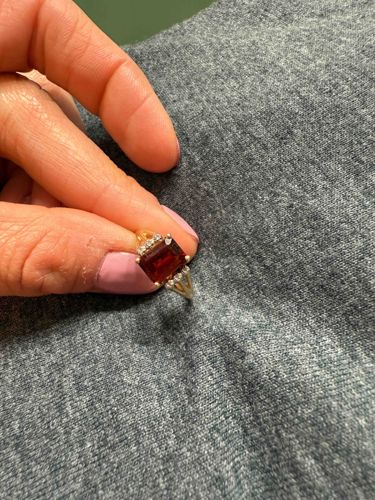
This is a gold-tone ring featuring a prominent rectangular, emerald-cut gemstone of deep red hue, likely a garnet or a similar stone known for its rich red color. The central stone is surrounded by a halo of small, clear, round brilliant-cut stones, which appear to be diamonds or diamond simulants, set in what looks to be a pave or bead setting. The band of the ring also has accent stones set on its shoulders, tapering towards the bottom. The metal appears to be yellow gold, possibly 10K or 14K, given its color saturation. The setting for the main stone features visible prongs at each corner, securing the gem in place. Some minor wear on the metal band is possible, as indicated by the slight dulling in areas, but the stones appear to be intact and without significant chips or scratches visible from this perspective. The craftsmanship seems of decent quality, with the stones well-aligned. No distinct maker's marks or hallmarks are discernible from the image. The overall style suggests a classic and timeless design, possibly from the mid-to-late 20th century or a contemporary piece inspired by vintage aesthetics. The piece exhibits good visual condition, with no overt signs of damage or repair.
AI Appraisal Report
I have examined the provided image of this red gemstone ring with a diamond halo. Based on my visual assessment, the ring appears to be in good overall condition. The central stone, an emerald-cut deep red gem (likely garnet, given its hue and prevalence in such designs), seems intact with no visible chips or scratches. The surrounding halo and shoulder accents, appearing to be small, clear, round brilliant-cut stones, also appear secure and intact. While I suspect these are diamonds due to their fire, it is important to note that without direct inspection, I cannot definitively rule out diamond simulants (e.g., cubic zirconia, moissanite). The metal appears to be yellow gold, possibly 10K or 14K, exhibiting some minor wear consistent with gentle use, but no significant damage or repair is evident. The craftsmanship appears decent, with stones well-aligned.
In terms of market conditions, similar styles featuring prominent colored gemstones with diamond halos are consistently in demand, appealing to collectors who appreciate classic designs. The 'timeless' aesthetic contributes to stable market interest. Demand for vintage-inspired pieces remains strong. While not exceptionally rare, the combination of an attractive deep red stone and diamond accents ensures a steady market presence.
Factors significantly impacting value include the actual type and quality of the red gemstone (different red stones like ruby, although unlikely given the visual, would fetch significantly higher values), the clarity, cut, and carat weight of the accent stones (if indeed diamonds), and the purity of the gold. Without knowing these specifics, and especially without confirming the diamond authenticity, a precise valuation is difficult.
Limitations: My assessment is based purely on visual examination of an image. Authenticity verification of the red gemstone (e.g., identity, natural vs. synthetic, treatments), the accent stones (diamonds vs. simulants), and the metal purity cannot be definitively confirmed without in-person examination, professional gemological testing (e.g., refractive index, specific gravity, spectroscopy), and assessing for hallmarks or maker's marks. Provenance documentation would also add significant value and authenticity.
Considering these factors, I estimate the value within a range that reflects its visual appeal and condition, acknowledging the unknown variables.