AI estimate as of October 26, 2025 · verify with a professional before acting
AI-Generated · Verify before acting
Everything on this page is generated by AI for informational purposes only. AI can make mistakes — the AI may misidentify items or misattribute them (artist, maker, brand, designer, origin, era). This is not an official valuation and should not be used for insurance, sale, tax, estate, legal, or lending purposes — or any decision requiring a certified appraisal. It is not an authoritative claim about any person, brand, or rights holder — do not share or rely on it as a factual statement about a third party. Always consult qualified professionals before making financial decisions.
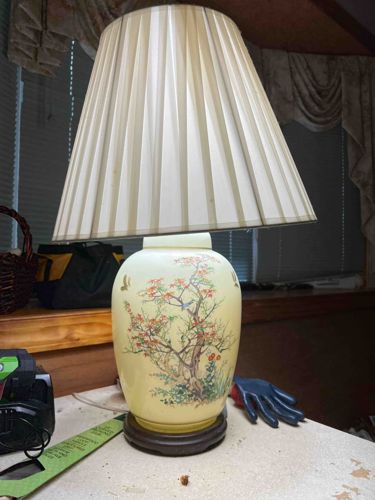
This item is a decorative table lamp featuring an Asian-inspired design. The lamp consists of a body resembling a ginger jar, a pleated fabric lampshade, and a wooden base. The lamp body is crafted from what appears to be ceramic or porcelain with a pale yellow or cream glaze. It is adorned with a hand-painted or decal decoration depicting a vibrant flowering tree in shades of red, orange, and green, suggestive of a cherry blossom or similar ornamental tree. Small birds, possibly a bluebird, are perched among the branches, and butterflies or moths are shown fluttering around the tree. The artwork has a traditional Asian brushwork feel. The lamp rests on a dark brown, possibly stained wood, circular base with a slightly fluted or carved edge. A cream-colored, pleated fabric lampshade tops the lamp, exhibiting vertical pleats that create a textured and diffused light effect when illuminated. The shade appears to be in fair condition, with some visible signs of age or wear, including possible discoloration or light staining along some of the pleats, suggesting it might be an older piece. There are no visible manufacturer's marks or signatures in the provided image. The overall style suggests an age perhaps from the mid-20th century to late 20th century, consistent with decorative lamps popular in traditional or Chinoiserie interior design. The craftsmanship of the painted body seems to be of a reasonable quality for mass-produced decorative items, with clear details in the botanical illustration. The lamp's functionality cannot be assessed from the image alone, but it appears to be complete with its shade and base.
AI Appraisal Report
I have examined the provided image of this Asian-Inspired Ginger Jar Table Lamp. The lamp features a ceramic or porcelain body with a pale glaze, adorned with a hand-painted or decal decoration depicting a flowering tree, birds, and butterflies, consistent with traditional Asian botanical motifs. It rests on a dark wooden base and is topped with a cream-colored pleated fabric lampshade. The overall condition appears fair; while the body and base seem intact, the lampshade exhibits visible signs of age, including potential discoloration or staining, which is common for older fabric shades. There are no visible manufacturer's marks or signatures, which limits definitive attribution or age assessment.
Authenticity of the artwork being truly hand-painted versus a decal cannot be definitively confirmed without closer in-person inspection. Without examination of the internal wiring, switch, and socket, functionality cannot be assessed. This type of decorative lamp was popular from the mid to late 20th century, often mass-produced, reflecting a Chinoiserie aesthetic.
Market conditions for such decorative lamps are generally stable but not highly appreciating, especially for unmarked items. Comparable items, typically found in vintage and antique markets or online, range widely based on condition, manufacturer, and artistic quality. Given the apparent mass-produced nature and lack of specific provenance or maker’s marks, rarity is low. The primary factors impacting value are its decorative appeal, functional condition (which is unverified), and the condition of the shade. Its appeal lies in its decorative quality and potential to complement traditional or vintage interiors.
For full authentication, a physical examination would be necessary to inspect the paint application (brushstrokes vs. decal), identify any hidden marks, assess wiring integrity for safety, and truly evaluate the shade's condition. Provenance documentation, if available, would significantly aid in verifying its origin and age.