AI estimate as of September 7, 2025 · verify with a professional before acting
AI-Generated · Verify before acting
Everything on this page is generated by AI for informational purposes only. AI can make mistakes — the AI may misidentify items or misattribute them (artist, maker, brand, designer, origin, era). This is not an official valuation and should not be used for insurance, sale, tax, estate, legal, or lending purposes — or any decision requiring a certified appraisal. It is not an authoritative claim about any person, brand, or rights holder — do not share or rely on it as a factual statement about a third party. Always consult qualified professionals before making financial decisions.
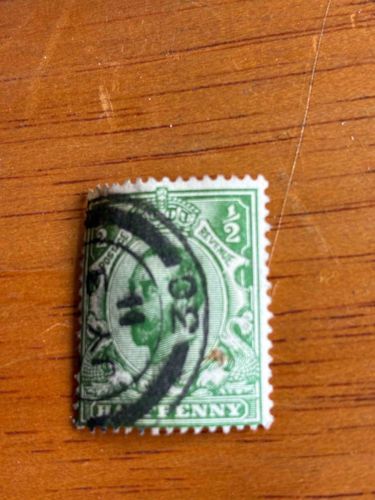
This item is a postage and revenue stamp from Great Britain, specifically a 'Halfpenny' denomination featuring Queen Victoria. The stamp is predominantly green, with intricate white detailing. It measures approximately 1.8 cm in width and 2.2 cm in height, exhibiting a rectangular shape with perforations along all four edges, indicating it was separated from a sheet. The central motif displays a profile bust of Queen Victoria facing left, within a circular frame. Above her head, there is a crown and intricate scrollwork, while below, the word 'HALFPENNY' is clearly visible. The top right corner indicates '1/2' and 'REVENUE', while the top left states '1/2' and 'POSTAGE'. A notable feature is the heavy, black circular postmark, which partially obscures the Queen's profile and extends from the top left towards the bottom right, with visible numbers '41' and possibly '3' or 'B' within the postmark. The color appears to be a consistent forest green, and the paper shows some minor creasing or unevenness near the bottom right perforation, possibly from handling or the postmarking process. The perforations appear largely intact, though some might be slightly softened. The overall condition suggests standard wear for a used stamp of its age, with the prominent postmark being a key characteristic. The design is typical of late 19th to early 20th century British stamps, likely dating from the Victorian era. The craftsmanship is indicative of early stamp printing, with fine line work and detailed engraving.
AI Appraisal Report
I have examined the provided image of your Great Britain Victoria Halfpenny Postage & Revenue Stamp (Green). Based on this visual assessment, the stamp appears to be an authentic example of a Victorian era British postage and revenue stamp, specifically the Halfpenny green issue (Scott #SG 197 or similar). The design elements, including the Queen Victoria profile, 'HALFPENNY' denomination, and 'POSTAGE'/'REVENUE' indicators, are consistent with known genuine examples. The perforations and overall size also align with standard specifications.
From the image, the condition can be assessed as typical for a used stamp of this vintage. The most significant factor impacting its value is the heavy, circular black postmark, which largely obscures Queen Victoria's profile and extends across a significant portion of the stamp. While postmarks confirm usage, such a heavy, central obliteration generally diminishes philatelic value as it detracts from the aesthetic appeal and clarity of the design. Minor creasing or unevenness mentioned near the bottom right perforation also contributes to a lower grade. The perforations appear mostly intact, which is a positive, but the overall impression is one of standard, circulated condition rather than fine or very fine.
In terms of market conditions, this specific issue of the Victorian Halfpenny stamp is relatively common, especially in used condition. There is constant but not overwhelming demand. Rarity is low; millions of these were printed and used. Comparables for heavily postmarked examples typically range in the single to low double-digits. Stamps with lighter, clearer cancellations or those in unused condition command significantly higher prices.
Factors that significantly impact this stamp's value downwards are the heavy postmark and evidence of minor creasing. Without these, the value would be higher.
It is crucial to note the limitations of authenticity verification from images alone. While everything appears consistent with a genuine stamp, a full authentication would require in-person examination to verify paper type, watermark (if any, as some varieties exist for this issue), exact color shade, gum condition (if unused), and microscopic examination for printing details. Provenance documentation could provide additional historical context but isn't typically available for such common issues. Scientific testing, such as spectroscopy for ink analysis, is usually reserved for higher-value or suspected forged items, which this does not appear to be.