AI Appraisal Estimate

AI-generated estimates · not official valuations

From the user

What was submitted

Photo and notes provided by the user — not generated by AI

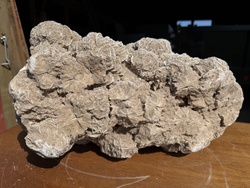
Submitted item photo
Submitted photo · July 18, 2026

User's notes

found

AI analysis below

AI appraisal

AI analysis & estimate

AI-Generated · Verify before acting

Everything below is generated by AI for informational purposes only. AI can make mistakes — the AI may misidentify items or misattribute them (artist, maker, brand, designer, origin, era). This is not an official valuation and should not be used for insurance, sale, tax, estate, legal, or lending purposes — or any decision requiring a certified appraisal. It is not an authoritative claim about any person, brand, or rights holder — do not share or rely on it as a factual statement about a third party. Always consult qualified professionals before making financial decisions.

Note

This analysis also relies on unverified notes provided by the user, which may be incomplete or inaccurate and could affect the result.

Read the full disclaimer

AI Identification

·Not independently authenticated·Verify before acting

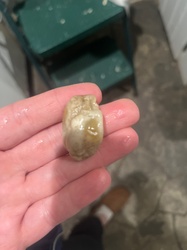
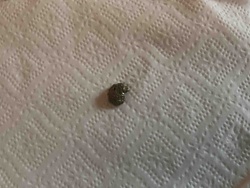
Polished geode slice or agate nodule fragment

Minerals and Natural History

AI Estimated Value

·Not an official valuation·Verify before acting

$10 - $25

As of July 18, 2026

AI Item Analysis

·AI can make mistakes·Verify before acting
This item appears to be a section of a natural geode or agate nodule, possibly prepared as a coaster or decorative display piece. The specimen features a translucent, chalcedony-like interior with a grayish-white hue and a denser, more opaque white or cream-colored inclusion at the center which may be a druzy quartz formation or a secondary mineral deposit. The outer edge or 'rind' is visible as a rough, serrated border with brownish and tan earthy tones, stylistically consistent with the exterior of a basalt or sedimentary rock casing from which geodes are often extracted. The surface appears to have been polished to a smooth finish, though the image focus makes it difficult to assess the level of luster. Regarding its origin, the item is noted as 'found' by the user, a claim that remains unverified as the geological provenance cannot be determined from photographs alone. There are no visible maker's marks, signatures, or identifying labels. The piece shows some irregularities along its perimeter which appear consistent with the natural fractures of mineral extraction rather than intentional damage. Given its appearance, it is consistent with mid-20th-century to modern lapidary work. Due to the lack of diagnostic markings, this identification is based solely on the visual similarity to common quartz and chalcedony specimens.
AI Appraisal Report

·AI can make mistakes·Verify before acting
Based on the provided image, I have examined this specimen which appears to be a polished slice of a chalcedony or quartz-based geode. The object exhibits a translucent, grayish-white interior surrounding an opaque central inclusion, characteristic of common volcanic or sedimentary nodules. Based on what I can see, the perimeter shows a natural, textured rind with brownish tones. I cannot verify the specific mineral hardness, chemical composition, or precise geological origin from a photo alone; such determination would require physical testing like a Mohs scale scratch test or specific gravity measurement. The value estimate is based on the assumption that this is a natural specimen as the user submission suggests it was 'found.' The current market for common agate and quartz slices typically values them as decorative accents or lapidary material. Pieces of this size and color profile generally command modest prices. The lack of vibrant banding, 'fire' (as seen in precious opals), or rare crystallization like amethyst reduces its market premium. This estimate assumes the item is a natural stone. If it were a synthetic glass imitation, the value would be negligible ($1-$5). Conversely, if scientific testing revealed a rare mineral inclusion not visible here, the value could increase slightly. To confirm its nature, an in-person examination by a mineralogist would be necessary. Generally, the demand for common gray chalcedony is stable but low, as these items are frequently mass-produced for the giftware market. Without documented provenance or a more specific geological locality, it remains valued as a generic natural history specimen.

Related Tags

Explore similar items and categories

Get your items appraised

Instant estimates of your treasures with AI-powered appraisals

Browse More Appraisals