AI estimate as of November 21, 2025 · verify with a professional before acting
AI-Generated · Verify before acting
Everything on this page is generated by AI for informational purposes only. AI can make mistakes — the AI may misidentify items or misattribute them (artist, maker, brand, designer, origin, era). This is not an official valuation and should not be used for insurance, sale, tax, estate, legal, or lending purposes — or any decision requiring a certified appraisal. It is not an authoritative claim about any person, brand, or rights holder — do not share or rely on it as a factual statement about a third party. Always consult qualified professionals before making financial decisions.
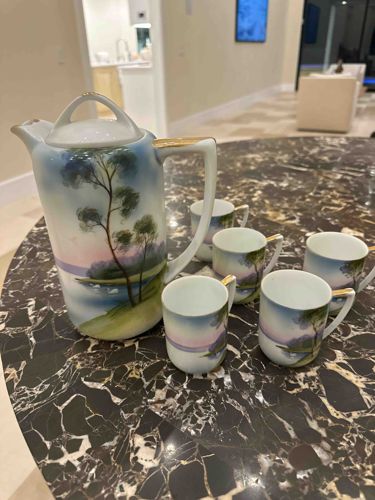
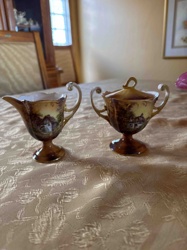
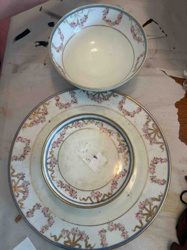
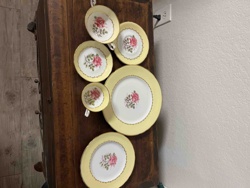
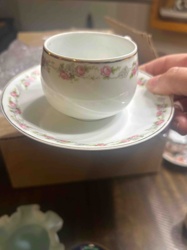
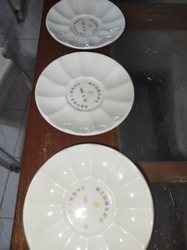
This exquisite set comprises a porcelain chocolate pot and six matching demitasse cups, all adorned with a hand-painted scenic landscape decoration. The primary color palette features soft lavenders, blues, greens, and pinks, transitioning into a calming sky over a body of water, flanked by dark green trees and lighter green foreground elements, creating a tranquil atmosphere. The porcelain itself appears to be white, providing a clean canvas for the artwork. Both the pot and the cups feature delicate gold accents on their handles and rims, indicating a level of refinement and attention to detail. The chocolate pot is tall and slender with a distinct pouring spout, a gracefully curved handle, and a fitted lid, suggesting its traditional use for serving hot chocolate. The demitasse cups are small, handle-less or with very small single handles, characteristic for serving strong coffee or espresso, though in this context, they would likely be used for enjoying hot chocolate. The overall design suggests an Art Nouveau or early 20th-century aesthetic, likely between 1890 and 1920, a period known for its elaborate hand-painted porcelain wares. While no specific maker's marks or signatures are visible in the provided image, the consistent artistic style across all pieces strongly suggests they are part of a unified set. The condition appears to be relatively good, with no obvious chips, cracks, or significant paint loss discernible from the image, although minor wear to the gold gilding, consistent with age and handling, would not be unexpected. The craftsmanship indicates a factory-produced blank piece, meticulously hand-decorated, showcasing skilled brushwork and artistic composition, which would have been highly valued during its creation period.
AI Appraisal Report
Based on my visual examination of the provided image, this Porcelain Hand-Painted Chocolate Pot Set with Six Demitasse Cups presents as a lovely example of early 20th-century decorative porcelain. The condition appears good, with no overt chips, cracks, or significant paint loss; however, minor wear to the gold gilding, common with age and handling, is anticipated. Authenticity as a unified set is strongly supported by the consistent artistic style and color palette across all pieces, characteristic of a factory-produced and then meticulously hand-decorated item. The chosen scenic landscape, soft color palette, and gold accents align with Art Nouveau or early 20th-century aesthetics (1890-1920).
Market conditions for such decorative chocolate sets remain stable, though not exceptionally high. Comparable hand-painted sets of similar age and quality, often unsigned, typically fetch between $300 and $700 at auction or through reputable dealers. Demand is steady among collectors of period porcelain, especially those appreciating hand-painted artistry. The rarity is moderate; while many such sets were produced, finding a complete set in good condition can be challenging. The primary factors impacting value are its completeness, good condition, and charming hand-painted decoration.
It is crucial to note that this appraisal is based solely on visual inspection of the image. For full authentication and to confirm condition nuances, an in-person examination is essential. This would allow for a thorough check for hairline cracks, touch-ups, actual gilding wear, and potential maker's marks or signatures that might be obscured or not visible in the image. Scientific testing (e.g., UV light examination) could detect repairs not apparent to the naked eye. Provenance documentation, if available, would also significantly enhance authenticity and value, but none was provided.