AI estimate as of July 24, 2025 · verify with a professional before acting
AI-Generated · Verify before acting
Everything on this page is generated by AI for informational purposes only. AI can make mistakes — the AI may misidentify items or misattribute them (artist, maker, brand, designer, origin, era). This is not an official valuation and should not be used for insurance, sale, tax, estate, legal, or lending purposes — or any decision requiring a certified appraisal. It is not an authoritative claim about any person, brand, or rights holder — do not share or rely on it as a factual statement about a third party. Always consult qualified professionals before making financial decisions.
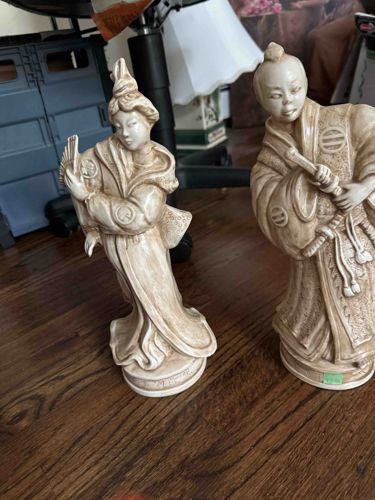
The items are a pair of East Asian-inspired decorative figurines, likely constructed from a resin or composite material that mimics the appearance of carved ivory or aged bone. They feature a monochromatic, off-white to cream color palette with intentional antiquing or staining in the recessed areas to enhance detailing and provide a sense of age. The texture appears to be matte with some subtle sheen on the raised surfaces. Each figurine stands on a circular base. The figure on the left depicts a female, possibly a geisha or noblewoman, with an elaborate updo hairstyle, holding an open fan. Her attire is highly detailed, showing flowing robes with patterned sleeves and a sash. The figure on the right is a male, depicted standing proudly, holding what appears to be a scroll or sword hilt. He also has a distinctive hairstyle, possibly a topknot, and is dressed in intricate robes with circular emblem-like designs on the shoulders and chest, reminiscent of traditional Japanese or Chinese garments. Both figures exhibit fine craftsmanship in their facial features, drapery of clothing, and accessories, although the material suggests mass production rather than unique hand carving. Observable condition issues include overall darkening in crevices consistent with accumulated dust and age, which could also be part of the intentional antiquing. No significant chips, cracks, or repairs are immediately visible from the provided images, though a small green sticker is present on the base of the male figure, possibly an inventory or price tag. The style suggests an East Asian cultural influence, likely dating from the mid to late 20th century, a period when such decorative items became popular in Western markets.
AI Appraisal Report
Based on my visual examination of the provided image, this pair of East Asian-inspired resin figurines appears to be in good overall condition. The monochromatic, off-white to cream color, along with the intentional antiquing in recessed areas, suggests a decorative item designed to mimic aged ivory or bone. There are no immediate visible signs of significant chips, cracks, or repairs beyond the inherent design elements and what appears to be accumulated dust or intentional darkening in crevices. A small green sticker on the male figure's base indicates a past inventory or price tag, common for retail items.
Authenticity: Given the material (resin/composite) and stylistic characteristics, these figurines are decorative reproductions rather than genuine antique ivory or hand-carved pieces. The uniform finish and intricate, yet consistent, detailing point towards mass production. Without a physical examination, I cannot definitively confirm the exact material composition, but the visual cues strongly suggest resin.
Market Conditions & Comparables: The market for mass-produced East Asian-inspired decorative objets d'art from the mid-to-late 20th century is generally stable but not highly lucrative. Similar resin or chalkware figurines often appear in estate sales, online marketplaces, and secondary retail shops. Common comparables include other resin or composite imitations of ivory, jade, or bronze figures from the same period.
Demand & Rarity: These items are not rare. There was a significant production of such decorative pieces for Western markets during the latter half of the 20th century. Demand is primarily from collectors of decorative arts, specific cultural aesthetics, or individuals seeking accent pieces for home decor. Rarity is low due to the mass-produced nature.
Factors Impacting Value: The material (resin), lack of rarity, and decorative rather than fine art status significantly limit the value. The good condition, as observed, maintains its decorative appeal, preventing it from having a negligible value. If these were genuinely carved ivory, their value would be substantially higher, subject to strict regulations regarding trade.
Limitations & Further Testing: My appraisal is limited by my inability to physically inspect the items. A hands-on examination would allow for tactile assessment of material, weight, and detailed scrutiny for hairline cracks, touch-ups, or material inconsistencies not visible in images. Provenance documentation (original purchase receipts, artist/manufacturer information) would help confirm production history. Scientific testing, such as spectroscopy, could definitively confirm material composition if there was any doubt regarding resin versus natural materials.