These notes were written by the person who submitted this item. Appraiser.AI has not verified them, and the AI's identification and estimate may rely on them.
AI Estimated Value
Not an official valuation
$100-200
AI estimate as of October 8, 2025 · verify with a professional before acting
AI-Generated · Verify before acting
Everything on this page is generated by AI for informational purposes only. AI can make mistakes — the AI may misidentify items or misattribute them (artist, maker, brand, designer, origin, era). This is not an official valuation and should not be used for insurance, sale, tax, estate, legal, or lending purposes — or any decision requiring a certified appraisal. It is not an authoritative claim about any person, brand, or rights holder — do not share or rely on it as a factual statement about a third party. Always consult qualified professionals before making financial decisions.
This analysis also relies on unverified notes provided by the user, which may be incomplete or inaccurate and could affect the result.
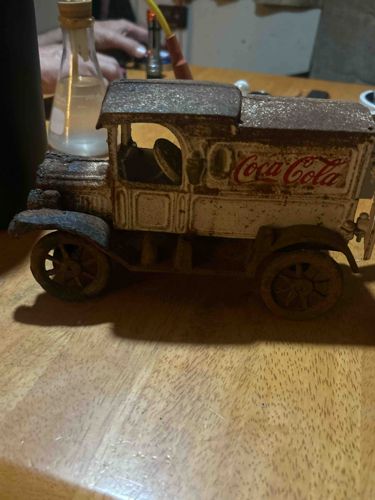
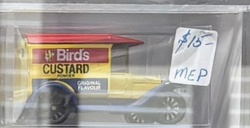
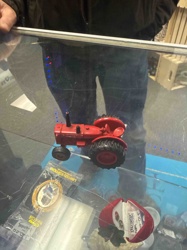
This item is a vintage cast iron toy truck, likely a replica of an early 20th-century delivery vehicle, specifically branded for Coca-Cola. The primary material appears to be cast iron, evident from the heavy, somewhat rough texture, and the significant rust and paint loss. The original color scheme seems to have been predominantly white or cream for the body, with red lettering for the 'Coca-Cola' logo on the side of the truck bed. The roof and fenders, and possibly the wheels, show remnants of a darker, perhaps black or dark brown, finish that has largely rusted away to reveal the raw iron beneath.
The truck features a distinct cab with open sides, revealing a steering wheel inside. The truck bed is enclosed, characteristic of a delivery vehicle, with the 'Coca-Cola' branding prominently displayed on the side. The wheels are solid, multi-spoked, and appear to be integrated into the cast iron construction rather than being separate, rotatable parts. The overall construction suggests a robust, albeit simple, design common in early toy manufacturing.
Condition issues are significant: there is substantial surface rust across almost all exposed metal surfaces, particularly on the roof, fenders, and edges of the truck body. The original paint has deteriorated extensively, with large areas flaked off, exposing the rusted iron beneath. This heavy wear indicates considerable age and possible exposure to elements or harsh play. There are no visible maker's marks or signatures apparent from the provided image, but its style is consistent with cast iron toys produced in the early to mid-20th century. The sturdy construction and prominent branding suggest it was a promotional item or a popular toy during its era. The item's primary appeal now lies in its antique/collectible value due to its branding and age, despite its heavily 'played-with' or aged condition.
AI Appraisal Report
This vintage cast iron Coca-Cola delivery truck toy, while exhibiting significant wear, presents as an authentic piece consistent with early to mid-20th century toy manufacturing. My assessment of its authenticity relies on visual cues—the characteristic heavy, somewhat rough texture of cast iron, the integrated wheel design typical of the era, and the style of the Coca-Cola branding. The substantial surface rust and extensive paint loss across virtually all surfaces indicate heavy use and considerable age. The original white/cream body with red 'Coca-Cola' lettering is still discernible despite the deterioration.
Market conditions for severely worn cast iron toys, even branded ones, are moderate unless they are exceptionally rare or from highly collectible manufacturers. While the Coca-Cola branding adds significant appeal, the extent of the condition issues—specifically the heavy rust and flaking paint—noticeably impacts its value. Comparables for cast iron Coca-Cola trucks in 'played-with' condition typically range lower than those in better states of preservation. Demand exists among Coca-Cola collectors and vintage toy enthusiasts, but this piece falls into a niche where condition drives price significantly. Its value is primarily as a display piece showcasing age and history rather than pristine preservation. Factors impacting value negatively are primarily the extensive rust and paint degradation; conversely, the iconic branding positively influences its appeal.
It is crucial to note that while the visual evidence strongly suggests authenticity, a definitive verification requires in-person examination. A physical inspection would allow for tactile assessment of the casting quality, clearer identification of any obscured maker's marks or numbers, and a more precise understanding of the metal composition and paint remnants. Additionally, provenance documentation, such as original sales receipts or family history, would further solidify its authenticity. Without these, my appraisal is based solely on visual interpretation of the provided image.