These notes were written by the person who submitted this item. Appraiser.AI has not verified them, and the AI's identification and estimate may rely on them.
AI Estimated Value
Not an official valuation
$75-125
AI estimate as of August 7, 2025 · verify with a professional before acting
AI-Generated · Verify before acting
Everything on this page is generated by AI for informational purposes only. AI can make mistakes — the AI may misidentify items or misattribute them (artist, maker, brand, designer, origin, era). This is not an official valuation and should not be used for insurance, sale, tax, estate, legal, or lending purposes — or any decision requiring a certified appraisal. It is not an authoritative claim about any person, brand, or rights holder — do not share or rely on it as a factual statement about a third party. Always consult qualified professionals before making financial decisions.
This analysis also relies on unverified notes provided by the user, which may be incomplete or inaccurate and could affect the result.
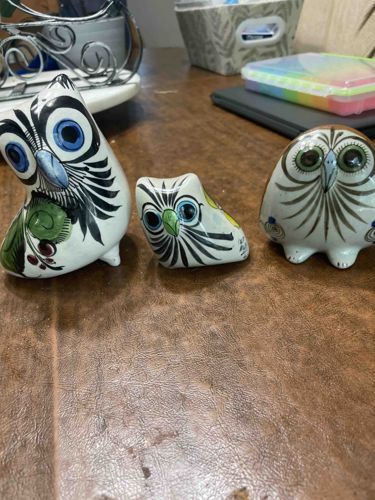
This is a collection of three hand-painted ceramic owl figurines, presented as an 'Owl Family' set. The figures vary in size, suggesting a parent and two offspring representation. They are crafted from glazed pottery, typical of Mexican folk art. The largest owl, positioned on the left, features prominent blue eyes with black pupils, outlined by white and black concentric rings, giving a wide-eyed, slightly whimsical expression. Its body is primarily white with black brushstrokes depicting feathers and distinct green and reddish-brown foliage or wing patterns on its lower left side. The medium-sized owl, in the center, has bright blue eyes with black pupils surrounded by lime green and white, also featuring black feathering details and hints of yellow. The smallest owl, on the far right, presents a more subdued color palette, primarily off-white with fine black and brown stripe work for the eyes and feathering, and subtle blue accents. All three pieces exhibit a glossy finish from the glaze. The pottery appears to be well-fired, with no immediate visible cracks or significant chips, suggesting good overall condition. There might be some minor surface wear consistent with handling or age, but without closer inspection, it's hard to distinguish from the natural variations inherent in hand-painted pottery. The style is distinctly Talavera-esque, a traditional Mexican earthenware characterized by its milky-white glaze and vibrant, often intricate, hand-painted designs. Given the context of 'Mexican pottery' and the signature 'El Palouma' (possibly a misspelling of 'El Paloma' or a unique artist/studio name), these pieces likely date from the mid to late 20th century to contemporary production, echoing traditional Mexican ceramic techniques. The craftsmanship appears to be of good quality for a folk art piece, with intentional brushstrokes and clear, defined patterns.
AI Appraisal Report
Based on my examination of the provided image and information, this 'Owl Family' by 'El Palouma' is a charming set of Mexican hand-painted ceramic figurines. The overall condition appears to be very good, with no visible cracks or significant chips, suggesting careful ownership. The glossy finish is consistent with glazed pottery, and the vibrant hand-painted details are characteristic of Mexican folk art, particularly reminiscent of Talavera style due to the milky-white glaze and bold colors. The distinct variations in size and painting style among the three owls add to their appeal.
From the image alone, authenticating 'El Palouma' definitively is challenging, as it could be a small studio, an individual artist, or even a slight misspelling. Without an in-person examination, it's impossible to verify the precise age or the quality of the ceramic body beneath the glaze. To fully authenticate and assess precise dating, I would require a physical inspection to check for maker's marks, specific clay body characteristics, and any aging indicators not visible in the image. Provenance documentation, such as purchase receipts or historical ownership, would also significantly aid in authentication.
In terms of market conditions, Mexican folk art, especially pieces with a whimsical or animal theme, generally has a consistent, albeit modest, demand among collectors of decorative arts. While 'El Palouma' is not a widely recognized name like major Talavera producers, the artistic execution appears well-done for a folk art piece. Rarity is difficult to ascertain without more information on the artist's output. Comparables for similar hand-painted Mexican ceramic owl sets by lesser-known artists typically range from $50 to $150, depending on size, detail, and condition. The 'family' aspect adds to its collectibility.
Factors impacting value include the good perceived condition, the appeal of the 'owl family' theme, and the hand-painted detailing. The primary limitation in valuation is the lack of a prominent artist signature or known studio, which would elevate value. Without physical inspection or further provenance, the value remains within the general folk art range.