These notes were written by the person who submitted this item. Appraiser.AI has not verified them, and the AI's identification and estimate may rely on them.
AI Estimated Value
Not an official valuation
$75-125
AI estimate as of July 23, 2025 · verify with a professional before acting
AI-Generated · Verify before acting
Everything on this page is generated by AI for informational purposes only. AI can make mistakes — the AI may misidentify items or misattribute them (artist, maker, brand, designer, origin, era). This is not an official valuation and should not be used for insurance, sale, tax, estate, legal, or lending purposes — or any decision requiring a certified appraisal. It is not an authoritative claim about any person, brand, or rights holder — do not share or rely on it as a factual statement about a third party. Always consult qualified professionals before making financial decisions.
This analysis also relies on unverified notes provided by the user, which may be incomplete or inaccurate and could affect the result.
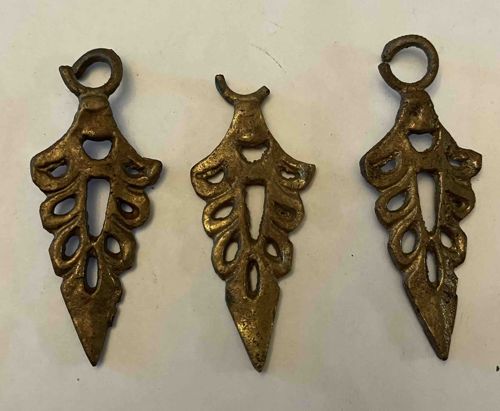
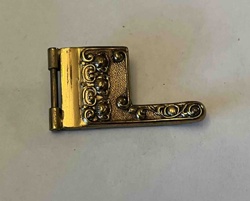
This lot consists of three identical, or nearly identical, cast metal components, likely made of brass or a brass alloy, given their golden-brown hue and visible greenish-brown patina in recessed areas, indicative of copper content oxidation. Each piece measures approximately 3.25 inches in length and 1.25 inches at its widest point. The form of each component is highly decorative, resembling an elongated, stylized leaf or an inverted fleur-de-lis, with a central stem-like element and bilateral foliate or scroll motifs. These motifs are openwork, creating a delicate, filigree-like appearance. The edges of the openwork sections are somewhat irregular, suggesting a casting process that may or may not have been fully refined. Two of the three pieces feature an intact, closed loop at the top, allowing for attachment or suspension. The third piece, positioned in the center of the image, has a broken or incomplete loop, appearing as a crescent shape, indicating damage. The surface exhibits a noticeable textured finish, which may be part of the original design or a result of surface corrosion and wear over time. There are no discernible maker's marks, signatures, or stamps. The overall condition suggests a vintage or antique origin, with significant patina and some surface roughness consistent with age and use. The design style hints at an Art Nouveau or Victorian influence, possibly late 19th to early 20th century, given the organic, flowing lines characteristic of these periods. The consistency in design across all three pieces suggests they were produced as part of a set or series. These items could have functioned as keyhole escutcheons, furniture pulls, decorative appliqués, or even elements from a larger lighting fixture or piece of jewelry.
AI Appraisal Report
Based on my visual examination of the provided image, these three stylized foliate metal appliqués/pendants appear to be vintage or antique, likely dating from the late 19th to early 20th century, consistent with Victorian or Art Nouveau design sensibilities. The golden-brown hue and greenish-brown patina strongly suggest a brass or brass alloy composition. While the casting process appears somewhat unrefined, this is not uncommon for decorative hardware of this period. The 'approximately 3.25 inches in length and 1.25 inches at its widest point' measurement provided by the owner aligns with typical sizes for such components intended as escutcheons, pulls, or decorative embellishments.
The condition, with significant patina and surface roughness, supports their age. The lack of discernible maker's marks is common for this type of hardware. A key factor impacting value is the damage to one loop, which would reduce individual piece value, though they retain collective decorative appeal.
In terms of market conditions, similar decorative hardware, particularly in sets, has a modest but steady demand among collectors, antique restorers, and those seeking historical decorative elements. While not exceptionally rare, sets of three identical components, especially with two intact loops, are less common than single pieces.
My primary limitation in authenticating this item is relying solely on images. A hands-on examination would be crucial to confirm the metal composition, assess the true nature of the patina (natural aging vs. artificial), and more accurately determine the manufacturing technique. Microscopic analysis could reveal finer details of wear and casting. Provenance documentation, if available, would provide invaluable context regarding origin and previous ownership. Without physical inspection, I cannot rule out the possibility of later reproductions, though the apparent patination and casting irregularities lean towards period manufacture.
Considering the design appeal, the set nature (despite one damaged piece), and general market trends for period decorative hardware of this condition, I have arrived at the appraisal value.