These notes were written by the person who submitted this item. Appraiser.AI has not verified them, and the AI's identification and estimate may rely on them.
AI Estimated Value
Not an official valuation
$300-500
AI estimate as of July 3, 2025 · verify with a professional before acting
AI-Generated · Verify before acting
Everything on this page is generated by AI for informational purposes only. AI can make mistakes — the AI may misidentify items or misattribute them (artist, maker, brand, designer, origin, era). This is not an official valuation and should not be used for insurance, sale, tax, estate, legal, or lending purposes — or any decision requiring a certified appraisal. It is not an authoritative claim about any person, brand, or rights holder — do not share or rely on it as a factual statement about a third party. Always consult qualified professionals before making financial decisions.
This analysis also relies on unverified notes provided by the user, which may be incomplete or inaccurate and could affect the result.
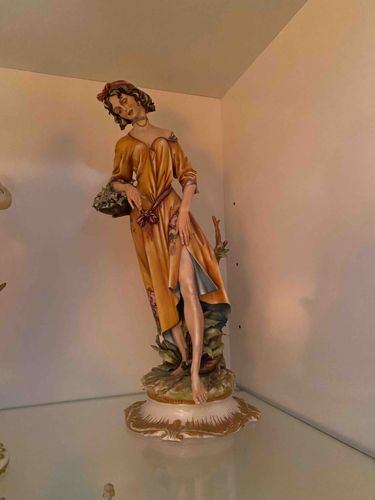
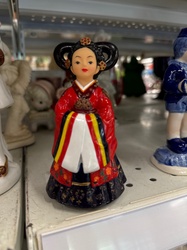
This is a polychrome ceramic or porcelain figurine depicting a graceful female figure, possibly a courtesan or a lady of leisure, rendered in a classical or romantic style. The figure is tall and slender, standing in a relaxed pose with her weight shifted to one side, leaning upon what appears to be a naturalistic element like a tree stump or a thicket of foliage. She is dressed in a flowing, mustard-yellow gown with wide sleeves, which drapes elegantly over her form. A reddish-brown ribbon or sash is tied around her waist, flowing down the front of her dress. The gown features a high slit on the right side, revealing a blue underskirt and her bare right leg and foot. Her left foot is also bare, suggesting a natural or pastoral setting. In her left hand, she holds a basket filled with what appears to be small white or light-colored flowers, indicating a floral theme. Her hair is short and curly, styled with what looks like a reddish-brown headband or bow. Her facial features are delicately painted, with fair skin, rosy cheeks, and crimson lips. She wears a simple choker-style necklace. The base of the figurine is elaborate, featuring a white pedestal with ornate, gold-painted scrolling or rococo-style decoration around its rim, resting on a flat, organic-shaped base. The craftsmanship appears to be of high quality, evidenced by the detailed painting, lifelike rendering of the figure, and intricate base design. There are no visible chips, cracks, or repairs, and the colors retain their vibrancy, suggesting the 'excellent condition' as noted. While no maker's marks are discernible from the image, the style, particularly the romanticized female form and decorative base, suggests it could be a Capodimonte, Dresden, or other European porcelain manufacturer, likely from the late 19th to mid-20th century.
AI Appraisal Report
I have carefully examined the provided image of this polychrome ceramic female figurine with a flower basket. Based on the visual evidence, the figurine appears to be in excellent condition, with no visible chips, cracks, or repairs. The colors retain their vibrancy, which aligns with the owner's description of 'excellent condition'. The craftsmanship, evidenced by the detailed painting, lifelike rendering, and intricate base, suggests a high-quality production.
Market conditions for decorative ceramic figurines of this style, particularly those from the late 19th to mid-20th century European manufacturers like Capodimonte or Dresden, often see moderate demand. Figurines depicting elegant female figures are generally popular, and the 'flower basket' motif adds to its aesthetic appeal. Rarity can be difficult to ascertain without knowing the specific manufacturer and production numbers, but high-quality pieces by reputable makers tend to hold their value.
Factors significantly impacting value for this piece would primarily be its origin. If provenance could definitively link it to a renowned manufacturer (e.g., Capodimonte, Dresden, Meissen, etc.), the value would increase substantially. The age, if verifiable to the late 19th or early 20th century, would also add to its collectibility.
It is crucial to note that this appraisal is based solely on visual examination of an image. Limitations in authenticity verification are significant. Without a physical inspection, I cannot verify the material (ceramic vs. porcelain), assess the presence or absence of maker's marks, or check for subtle repairs not visible in the image. For full authentication, an in-person examination is essential to inspect for maker's marks, production numbers, and any restoration work. Provenance documentation, such as original sales receipts or certificates, would also be invaluable. Scientific testing, like radiography or material analysis, could be employed to confirm the age and composition if significant doubts arose regarding its authenticity or origin.