AI estimate as of October 25, 2025 · verify with a professional before acting
AI-Generated · Verify before acting
Everything on this page is generated by AI for informational purposes only. AI can make mistakes — the AI may misidentify items or misattribute them (artist, maker, brand, designer, origin, era). This is not an official valuation and should not be used for insurance, sale, tax, estate, legal, or lending purposes — or any decision requiring a certified appraisal. It is not an authoritative claim about any person, brand, or rights holder — do not share or rely on it as a factual statement about a third party. Always consult qualified professionals before making financial decisions.
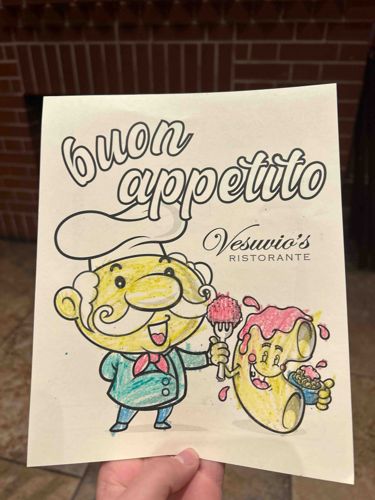
This item is a children's activity sheet or menu from a restaurant named 'Vesuvio's Ristorante'. The sheet is made of white or off-white paper, likely standard printer or commercial weight paper, measuring approximately 8.5 x 11 inches, as suggested by the hand holding it. The paper shows some minor creasing and handling wear, particularly visible around the edges and where the hand grips it, indicating it has been used or recently handled. The artwork features a cartoon chef character, drawn with a large mustache and a traditional chef's hat, colored primarily in yellow for his skin/mustache, a light green jacket, and blue pants. His bow tie is red. He appears to be offering a 'meatball' on a fork to a personified macaroni noodle, which is also colored yellow and has a happy expression. The macaroni noodle is holding a small bowl of what appears to be more 'meatballs' or a similar dish. Both the chef and the macaroni are depicted with pink 'sauce' splatters, suggesting a playful, food-related theme. Above the characters, the phrase 'buon appetito' is printed in a stylized, cursive script, intended for coloring. Below this, the restaurant's name, 'Vesuvio's Ristorante', is printed in a more elegant, smaller cursive font. The main drawing is outlined in black, while the coloring within the lines is done using crayons or colored pencils, exhibiting a child's artistic style with some areas colored outside the lines and varying pressure in application. The overall condition suggests a typical piece of ephemeral restaurant promotional material, likely from the contemporary period, possibly 2000s-present, given the style of the cartoon and printing. There are no visible tears or significant damage, just general handling marks.
AI Appraisal Report
I have examined the provided image of the Vesuvio's Ristorante 'Buon Appetito' Children's Menu/Coloring Page. This item is a common example of restaurant ephemera, characterized by its promotional nature and intended use as a children's activity. The condition, based on visual assessment, shows minor creasing and handling wear, consistent with such an item that would be distributed to children in a dining setting. The coloring appears to be done with crayons or colored pencils, exhibiting a child’s typical artistic style. Authenticity, in terms of it being an actual coloring page from Vesuvio's Ristorante, seems high given the specific restaurant name printed on it and the typical design elements for such materials. However, without in-person inspection, I cannot verify the paper stock, precise printing methods, or confirm there isn't any hidden damage that might not be visible in the image.
Market conditions for restaurant ephemera, particularly modern children's menus, are generally niche. While there's a collector base for antique or historically significant menus, contemporary items like this typically hold sentimental rather than significant monetary value. Comparables would include similar children's activity sheets from other local or regional restaurants. Demand for such a specific, relatively recent item is low. Rarity is minimal as these items were mass-produced. Factors significantly impacting value in a negative way include its common nature, the fact it has been colored (which typically reduces collectibility for uncolored examples), and its lack of historical significance.
For full authentication, a physical examination would be crucial to assess paper quality, printing details, and confirm the absence of any repairs or significant damage not apparent from the image. Provenance documentation, such as where it was acquired and its specific date of issue, would add to its contextual value, though likely not its monetary value. Scientific testing is not applicable for this type of item.