AI estimate as of August 27, 2025 · verify with a professional before acting
AI-Generated · Verify before acting
Everything on this page is generated by AI for informational purposes only. AI can make mistakes — the AI may misidentify items or misattribute them (artist, maker, brand, designer, origin, era). This is not an official valuation and should not be used for insurance, sale, tax, estate, legal, or lending purposes — or any decision requiring a certified appraisal. It is not an authoritative claim about any person, brand, or rights holder — do not share or rely on it as a factual statement about a third party. Always consult qualified professionals before making financial decisions.
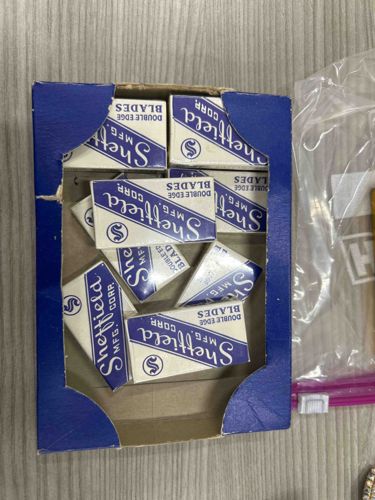
The item is a collection of "Sheffield Double Edge Blades" housed within what appears to be an original retail display box or carton designed to hold multiple blade packs. The individual blade packs are small, rectangular, and predominantly white with significant blue accents. Each pack features the brand name "Sheffield" written prominently in a stylized script font, alongside "MFG. CORP." and "DOUBLE EDGE BLADES" in a smaller, sans-serif typeface. A circular logo containing an 'S' is also visible on each pack. The display box itself is made of cardboard, with a predominantly blue exterior and a natural brown interior. It has cut-out sections on the front, consistent with an open-top display intended for easy access or viewing of the product by customers. The blue color on the box is somewhat faded and shows signs of wear, particularly around the edges and corners where the cardboard is creased or slightly torn, revealing the brown material underneath. The individual blade packs appear to be in generally good condition, though some might have minor discolorations or dust from storage. This item likely dates from the mid-20th century, given the design aesthetic and packaging style common for razor blades of that era. The overall craftsmanship points to mass production, typical for consumer goods, but the branding and consistent design suggest a standard level of quality for the period.
AI Appraisal Report
Upon examining the provided image of the Sheffield Double Edge Razor Blades (Box of), the item appears to be an authentic vintage retail display box filled with individual blade packs. The condition is generally good for its age, though the outer display box shows clear signs of wear, fading, and minor damage consistent with an item from the mid-20th century. The individual blade packs seem better preserved. Authenticity is supported by the consistent branding, period-appropriate design, and typical wear patterns for such an item.
Market conditions for vintage personal care items, particularly sealed or display-ready razor blade boxes, are niche but present. Comparables include other vintage blade display boxes from brands like Gillette, Schick, or Remington, which can fetch values based on brand recognition, completeness, and condition. This 'Sheffield' brand is less globally recognized than some, which slightly moderates its top-tier value.
Demand stems primarily from collectors of vintage advertising, shaving memorabilia, or general Americana. Rarity is moderate; while individual blade packs are common, a full display box in this condition is less so. Factors significantly impacting value include the completeness of the display box (i.e., how many blade packs are still inside), the overall condition of both the outer box and individual packs, and the visual appeal as a display piece. The wear on the outer box, while authentic, does somewhat detract from its pristine display value.
Limitations in authenticity verification from images alone exist. I cannot confirm if the blade packs are sealed or if the blades themselves are present inside. Physical examination would allow for inspection of the blade pack seals, verification of the contents (though opening would devalue it), and a more precise assessment of material degradation and dust. Provenance documentation would ideally confirm the item's origin and history, though for a consumer good like this, it's rarely available or expected. Scientific testing is generally not applicable or necessary for this type of item, beyond visual and tactile inspection for material integrity.