AI Appraisal Estimate

AI-generated estimates · not official valuations

From the user

What was submitted

Photo and notes provided by the user — not generated by AI

Submitted item photo
Submitted photo · June 1, 2026

User's notes

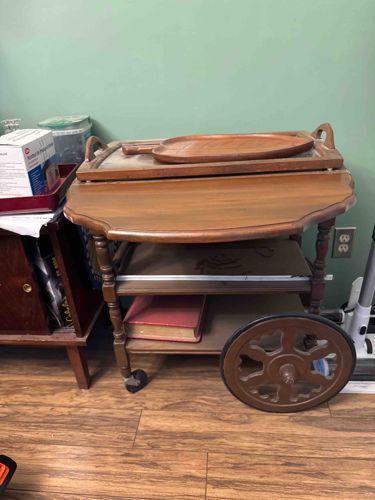
Tea wagon

AI analysis below

AI appraisal

AI analysis & estimate

AI-Generated · Verify before acting

Everything below is generated by AI for informational purposes only. AI can make mistakes — the AI may misidentify items or misattribute them (artist, maker, brand, designer, origin, era). This is not an official valuation and should not be used for insurance, sale, tax, estate, legal, or lending purposes — or any decision requiring a certified appraisal. It is not an authoritative claim about any person, brand, or rights holder — do not share or rely on it as a factual statement about a third party. Always consult qualified professionals before making financial decisions.

Note

This analysis also relies on unverified notes provided by the user, which may be incomplete or inaccurate and could affect the result.

Read the full disclaimer

AI Identification

·Not independently authenticated·Verify before acting

Early-to-Mid 20th Century Cherry Wood Drop-Leaf Tea Wagon

Antique/Vintage Furniture

AI Estimated Value

·Not an official valuation·Verify before acting

$250 - $450

As of June 1, 2026

AI Item Analysis

·AI can make mistakes·Verify before acting
This is a vintage three-tier tea wagon, often referred to as a tea trolley or beverage cart, constructed primarily of cherry wood with a medium-toned satin finish. The piece features a characteristic drop-leaf top with scalloped edges which, when extended, provides a larger rectangular serving surface. A notable component is the removable wooden glass-bottomed tray sitting atop the main surface, flanked by integrated wooden handles for serving utility. The cart is supported by four spindle-turned legs that exhibit traditional colonial revival or late Victorian influence. The middle and lower shelves are fixed, offering additional storage for service items. Mechanically, the wagon is designed with two large, decorative wooden wheels at the front containing stylized petal-like cutouts and black rubber treads, paired with smaller caster wheels at the rear for maneuverability. Regarding condition, the piece shows visible signs of age including surface scratches, dust accumulation, and minor scuffing along the lower tiers. The wood grain remains attractive, though the finish may require cleaning and conditioning. The cart appears to date from approximately the 1930s to 1950s, a period when such entertaining furniture was a staple of domestic middle-class hospitality.
AI Appraisal Report

·AI can make mistakes·Verify before acting
I have conducted a visual examination of this mid-20th-century cherry wood drop-leaf tea wagon. Structurally, the piece reflects the Colonial Revival aesthetic popular between 1930 and 1950. The use of cherry wood provides a desirable warmth, and the inclusion of the original glass-bottomed removable tray significantly bolsters its value, as these components are frequently lost over time. The larger 'petal' cutout wheels and spindle turning are characteristic of manufacturers like Paalman or Cushman, though no maker's mark is visible in the provided images. The condition appears fair to good; while the wood grain is well-preserved, visible surface abrasions and potential sun-fading on the lower tiers suggest a need for professional cleaning and wax conditioning to restore the satin finish. The market for tea trolleys is currently driven by the 'grandmillennial' and mid-century eclectic decor trends, which favor functional entertaining pieces. While not rare, examples with intact drop-leaves and original rubber treads on the wheels command a premium over simpler utility carts. Limitations of this virtual appraisal include the inability to verify the joinery methods (such as dowels vs. screws) or check for underside markings that would confirm the manufacturer. A physical inspection is required to ensure the axle stability and the absence of woodworm or structural cracks. Full authentication would benefit from provenance documentation or a surviving manufacturer’s label, which could potentially push the valuation toward the higher end of the estimated range.

Get your items appraised

Instant estimates of your treasures with AI-powered appraisals

Browse More Appraisals