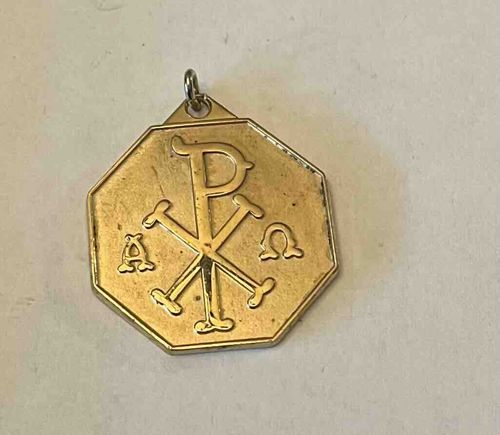
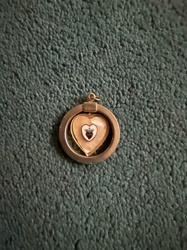
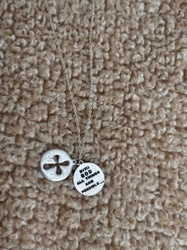
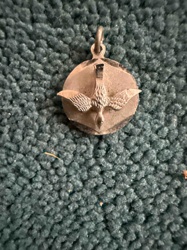
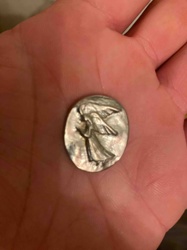
Charm approximately 2.5 cm in diameter, back says MONOGRAM OF CHRIST EASTERN ORTHODOX CHRISTIAN”
These notes were written by the person who submitted this item. Appraiser.AI has not verified them, and the AI's identification and estimate may rely on them.
AI Estimated Value
Not an official valuation
$40-60
AI estimate as of July 21, 2025 · verify with a professional before acting
AI-Generated · Verify before acting
Everything on this page is generated by AI for informational purposes only. AI can make mistakes — the AI may misidentify items or misattribute them (artist, maker, brand, designer, origin, era). This is not an official valuation and should not be used for insurance, sale, tax, estate, legal, or lending purposes — or any decision requiring a certified appraisal. It is not an authoritative claim about any person, brand, or rights holder — do not share or rely on it as a factual statement about a third party. Always consult qualified professionals before making financial decisions.
This analysis also relies on unverified notes provided by the user, which may be incomplete or inaccurate and could affect the result.
This item is an octagonal-shaped religious charm, approximately 2.5 cm (1 inch) in diameter, exhibiting a warm golden hue, suggesting it is likely made of brass, bronze, or a gold-plated base metal. The charm's front prominently features the Christian Chi-Rho symbol (☧), which is formed by the superimposition of the first two letters (Chi and Rho) of the Greek word "Christos" (Christ). A capital 'P' (Rho) is visible at the top, while an 'X' (Chi) forms the cross-like lower part of the monogram. Flanking the Chi-Rho, the Greek letters Alpha (Α) and Omega (Ω) are present, with Alpha situated to the lower left and Omega to the lower right. These letters symbolize God as the beginning and the end, referencing "I am the Alpha and the Omega, the First and the Last, the Beginning and the End" (Revelation 22:13). The symbols are raised from the surface, indicating a struck or cast manufacturing process, with a noticeable relief that gives the design depth. The background is a smooth, slightly reflective surface. A small, circular jump ring is attached to the top point of the octagonal charm, allowing it to be worn as a pendant or added to a bracelet. The metal shows some minor surface wear consistent with age and handling, including slight abrasions and a gentle, aged patina that enhances its antique appearance. There are no obvious signs of significant damage, repairs, or scratches, but the overall finish appears to be slightly dulled rather than highly polished, contributing to its vintage aesthetic. The back of the charm is inscribed with "MONOGRAM OF CHRIST EASTERN ORTHODOX CHRISTIAN," as per the provided context, which clearly identifies its religious and cultural significance. While no specific maker's marks or dates are observable from the image, the style and inscription suggest it is a devotional item likely from the 20th century, possibly mid to late 20th century, given its clean lines and standard production quality.
AI Appraisal Report
Upon examining the provided image and information for this octagonal Eastern Orthodox Chi-Rho Alpha Omega Charm, my initial assessment suggests it is a devotional item likely from the mid to late 20th century. The approximately 2.5 cm diameter charm, exhibiting a warm golden hue, appears to be made of brass, bronze, or a gold-plated base metal, as indicated by its appearance and typical manufacturing practices for such items. Its condition is good; I note only minor surface wear and a gently dulled patina consistent with age and careful handling. The raised Chi-Rho symbol flanked by Alpha and Omega, along with the inscription “MONOGRAM OF CHRIST EASTERN ORTHODOX CHRISTIAN” on the reverse, clearly establishes its religious significance.
In terms of market conditions, religious charms of this nature are generally common, affecting their rarity and, consequently, their value. While the specific Eastern Orthodox designation adds a niche appeal, the demand for such modern devotional pieces, absent precious metals or historical provenance, is moderate. Factors impacting value include the material (if solid gold, value would be significantly higher), specific dating, and any documented provenance. Without a physical inspection, I cannot definitively determine the exact metal composition, which is crucial for a precise valuation. Furthermore, an in-person examination would allow for a closer inspection of manufacturing techniques, assessment of patina authenticity, and potential identification of faint maker's marks not visible in images. Provenance documentation, though unlikely for a mass-produced item of this type, would also enhance its historical and collectible value. Scientific testing, such as XRF analysis, would be necessary to confirm metal composition. Based on visual assessment alone, and assuming base metal construction, this charm falls into the category of common religious jewelry.