These notes were written by the person who submitted this item. Appraiser.AI has not verified them, and the AI's identification and estimate may rely on them.
AI Estimated Value
Not an official valuation
$25 - $45
AI estimate as of November 28, 2025 · verify with a professional before acting
AI-Generated · Verify before acting
Everything on this page is generated by AI for informational purposes only. AI can make mistakes — the AI may misidentify items or misattribute them (artist, maker, brand, designer, origin, era). This is not an official valuation and should not be used for insurance, sale, tax, estate, legal, or lending purposes — or any decision requiring a certified appraisal. It is not an authoritative claim about any person, brand, or rights holder — do not share or rely on it as a factual statement about a third party. Always consult qualified professionals before making financial decisions.
This analysis also relies on unverified notes provided by the user, which may be incomplete or inaccurate and could affect the result.
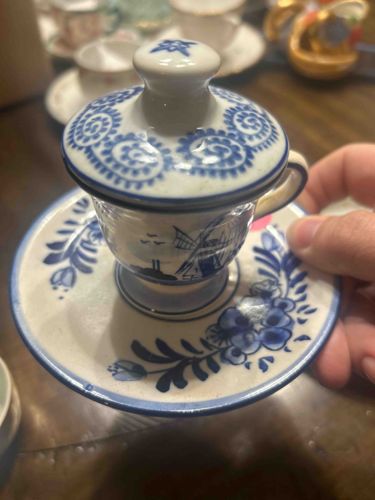
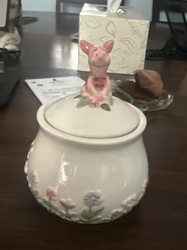
This is a miniature collectible ceramic cup and saucer set, complete with a matching lid, adorned with hand-painted Delft Blue-style decorations. The set is primarily white ceramic with cobalt blue motifs. The cup features a landscape scene with what appears to be a traditional Dutch windmill and flying birds, characteristic of classic Delftware. The saucer is decorated with floral and foliate patterns, including what look like tulips and other stylized blossoms, arranged around the rim. The lid mirrors the saucer's decorative style, featuring a spiral-and-dot pattern around its circumference, and a small, knob-like finial on top with a simple blue design. There is a small handle on the side of the cup. The edges of both the saucer and the lid have a blue rim, indicating attention to detail. Visible condition issues include some possible discoloration or dirt around the rim of the saucer, and potentially very minor wear consistent with handling or age. The quality of the hand-painting suggests a certain level of craftsmanship, though the miniature scale might allow for slight imperfections that add to its charm. The overall aesthetic points to an item made in the style of traditional Dutch Delftware, making its likely manufacturing period anywhere from the mid-to-late 20th century, assuming modern production, or possibly earlier given the enduring popularity of this style. The text 'D.A.L' from the context suggests a potential maker's mark or series identifier, which would be crucial for precise identification and dating. This set appears to be a decorative item, possibly a souvenir or part of a miniature collection.
AI Appraisal Report
I have examined the provided image and information for this Miniature Delft Blue Hand-Painted Cup and Saucer with Lid. This charming set presents as a decorative collectible in the classic Delftware style. The hand-painted 'D.A.L.C' inscription on the base is a key piece of information, likely representing a maker's mark or series. While 'D.A.L.C' isn't immediately recognizable as a prominent historical Delftware manufacturer, it points towards a specific studio or artist, which would be crucial for precise identification.
Condition-wise, based on the image, the set appears to be in very good to excellent condition for a miniature collectible. I noted potential minor discoloration or dirt on the saucer rim, which likely represents surface grime rather than significant damage, and typical minor wear consistent with handling. The hand-painting, though miniature, shows good detail, particularly the windmill scene and floral motifs. The inclusion of a lid adds completeness and appeal.
Regarding market conditions, miniature Delftware-style ceramics are generally popular, especially with collectors of miniatures or those seeking decorative accents. However, distinguishing between true antique Delftware, vintage reproductions, and modern decorative pieces is critical for value. Without specific historical maker's marks from renowned Dutch factories like De Porceleyne Fles (Royal Delft) or Tichelaar Makkum, this piece is more likely a mid-to-late 20th-century decorative item or souvenir, which is where the 'D.A.L.C' mark becomes important.
Its value is primarily driven by its decorative appeal, completeness, and hand-painted artistry. Demand for such charming, well-preserved miniatures is steady, but they are not inherently rare unless tied to a historically significant artist or factory. The miniature scale and decorative nature place it in a collectible category rather than an investment-grade antique.
My primary limitation in this appraisal is the lack of a physical examination. In-person inspection would allow me to thoroughly assess the ceramic body for crazing, chips, or repairs not visible in the image, determine the precise quality of the glaze and paint application, and better confirm the age and origin through tactile cues. Full authentication would require researching the 'D.A.L.C' mark within ceramic maker directories and potentially comparing it to known examples of their work. Without this, I cannot definitively confirm its precise origin, age, or specific authenticity as historic Delftware versus a quality reproduction.