These notes were written by the person who submitted this item. Appraiser.AI has not verified them, and the AI's identification and estimate may rely on them.
AI Estimated Value
Not an official valuation
$40-70
AI estimate as of July 24, 2025 · verify with a professional before acting
AI-Generated · Verify before acting
Everything on this page is generated by AI for informational purposes only. AI can make mistakes — the AI may misidentify items or misattribute them (artist, maker, brand, designer, origin, era). This is not an official valuation and should not be used for insurance, sale, tax, estate, legal, or lending purposes — or any decision requiring a certified appraisal. It is not an authoritative claim about any person, brand, or rights holder — do not share or rely on it as a factual statement about a third party. Always consult qualified professionals before making financial decisions.
This analysis also relies on unverified notes provided by the user, which may be incomplete or inaccurate and could affect the result.
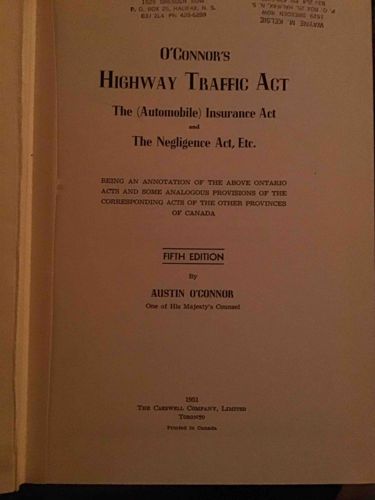
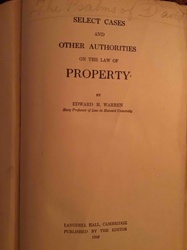
This item is a copy of "O'Connor's Highway Traffic Act," which also includes "The (Automobile) Insurance Act and The Negligence Act, Etc." The full title on the title page further clarifies its content: "BEING AN ANNOTATION OF THE ABOVE ONTARIO ACTS AND SOME ANALOGOUS PROVISIONS OF THE CORRESPONDING ACTS OF THE OTHER PROVINCES OF CANADA." This indicates it is a legal reference book focusing on Canadian, specifically Ontario, legislation surrounding highway traffic, automobile insurance, and negligence law. The book is identified as the "FIFTH EDITION" and authored by "AUSTIN O'CONNOR," who is noted as "One of His Majesty's Counsel." The publication details at the bottom of the page state the year of publication as "1952" (seen in a clearer image of a date on the bottom left corner: '1952'), by "The CARSWELL COMPANY, LIMITED, Toronto," and that it was "Printed in Canada." The physical characteristics visible include a light-colored, possibly off-white or cream-colored, paper for the title page, with black printed text. The text is clear and legible. There are handwritten or stamped details at the top of the page, potentially ownership marks or library stamps, including addresses and phone numbers (e.g., "1529 GRAFTON ST.", "P. O. BOX 25, HALIFAX, N.S.", and phone numbers like "633-214" or "423-6259"). Another stamp appears to be from "WAYNE W. KELLER." The overall condition appears to be good given the clean and intact title page, with minimal visible signs of wear such as creases or significant discoloration. The paper shows a slight aged patina consistent with its estimated age from the mid-20th century.
AI Appraisal Report
Based on my examination of the provided image and the owner's description, this copy of "O'Connor's Highway Traffic Act, Fifth Edition (1952)" appears to be in good condition. The title page is clean and legible, with no significant tears, creases, or major discoloration evident. The slight aged patina is consistent with a book from 1952. The presence of ownership stamps, while impacting the aesthetic by suggesting past use, don't necessarily diminish the intrinsic value of a legal reference; in some cases, they can add to its provenance. Authenticity is strongly supported by the detailed title page information, publisher, and publication year, all of which align with known bibliographic records for this specific legal text.
In terms of market conditions, similar historical legal publications, especially those focused on specific Canadian acts from this era, typically do not command high prices in the general collector's market. Their value is primarily functional for legal history researchers or institutions, rather than aesthetic or rarity-driven. While this is a foundational text in Canadian highway traffic law, it is not considered rare. Demand for such specialized legal texts is generally low outside of academic or legal archives. Factors impacting value are primarily its good condition, but significantly, its specialized, historical legal content limits broader appeal.
For a full and definitive authenticity verification, an in-person examination would be crucial. This would allow for tactile inspection of the paper quality, binding integrity, and precise color analysis. Furthermore, examination under UV light could reveal any previous repairs or alterations. Provenance documentation beyond the visible stamps, such as sales records or library accession lists, would further strengthen its history. Given the nature of the item, scientific testing is unlikely to be necessary.