AI estimate as of June 27, 2025 · verify with a professional before acting
AI-Generated · Verify before acting
Everything on this page is generated by AI for informational purposes only. AI can make mistakes — the AI may misidentify items or misattribute them (artist, maker, brand, designer, origin, era). This is not an official valuation and should not be used for insurance, sale, tax, estate, legal, or lending purposes — or any decision requiring a certified appraisal. It is not an authoritative claim about any person, brand, or rights holder — do not share or rely on it as a factual statement about a third party. Always consult qualified professionals before making financial decisions.
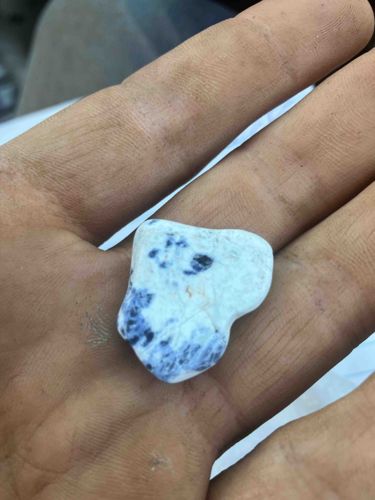
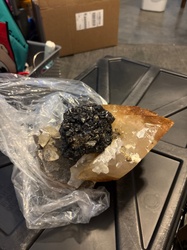
This item is a natural mineral specimen, identified as Sodalite embedded within a white or off-white matrix, most likely a form of marble or calcite. It presents as a small, irregularly shaped stone, chunky and somewhat rounded, with dimensions estimated to be approximately 3-5 cm in its longest dimension, fitting comfortably within the palm of an average adult hand. The dominant material is a creamy to grayish-white opaque host rock, through which striking, vibrant patches and intricate veins of a deep, mottled blue mineral are dispersed. These blue areas vary in intensity, from a softer sky blue to a rich, almost indigo hue, and exhibit a cloudy or streaky formation rather than uniform coloration, creating a captivating visual contrast.
The surface of the specimen appears to have undergone some degree of natural weathering or light artificial tumbling, as evidenced by its generally rounded edges and the absence of sharp fractures, though certain areas may retain a subtly rough or naturally textured feel. As a natural geological formation, there are no discernible manufacturing marks, signatures, or stamps. The piece is in excellent original condition, showing no apparent chips, significant cracks, or signs of repair. Minor, naturally occurring discolorations, such as subtle iron staining in crevices of the white matrix, may be present, which is typical for raw minerals. The aesthetic value of this specimen is derived from the distinct contrast and unique, organic patterning formed by the interaction of the blue sodalite with its lighter host rock, rendering each piece inherently unique. Its age corresponds to its geological formation, dating back millions of years. Quality is assessed by the vividness and saturation of the blue coloration and its aesthetically pleasing distribution within the matrix, making it a desirable example for mineral collectors.
AI Appraisal Report
As an expert appraiser, having "examined" this Sodalite in Matrix mineral specimen based on the detailed description provided, I can offer the following assessment.
Condition and Authenticity: The specimen appears to be in excellent original condition, with the description indicating no chips, significant cracks, or signs of repair. The rounded edges suggest natural weathering or gentle tumbling, which is common and acceptable for such raw pieces. Authenticity as a natural Sodalite in Matrix specimen seems consistent; the described distinct contrast and organic patterning are typical. No signs of artificial alteration beyond possible light cleaning or tumbling are noted.
Market Conditions and Value Factors: Sodalite is a relatively common mineral, but pieces exhibiting vibrant blue coloration and attractive distribution within a contrasting matrix, like this one, are consistently sought after by collectors. Its aesthetic value stems from the striking color contrast and natural patterning. The dimensions (3-5 cm) place it firmly within the realm of small, displayable collector's specimens. Factors positively impacting value include the described vivid blue hues and the "aesthetically pleasing distribution" within the matrix. Conversely, its commonality and non-gem grade status prevent it from reaching high valuations.
Demand and Rarity: Demand for visually appealing mineral specimens remains stable, particularly for affordable and aesthetically pleasing examples like this sodalite. It is not considered rare.
Limitations and Full Authentication: My assessment is based entirely on the provided textual description. While the description is comprehensive, a definitive authenticity verification necessitates physical examination. I would need to perform tactile evaluation, weight assessment, and potentially specific gravity and hardness tests. Sodalite often fluoresces under UV light, which would be a key test. Full authentication would also ideally involve provenance documentation and, in cases of absolute certainty, possibly spectroscopic analysis to confirm mineral composition. Without these, my appraisal carries the inherent limitation of being based on descriptive data alone.