AI estimate as of August 29, 2025 · verify with a professional before acting
AI-Generated · Verify before acting
Everything on this page is generated by AI for informational purposes only. AI can make mistakes — the AI may misidentify items or misattribute them (artist, maker, brand, designer, origin, era). This is not an official valuation and should not be used for insurance, sale, tax, estate, legal, or lending purposes — or any decision requiring a certified appraisal. It is not an authoritative claim about any person, brand, or rights holder — do not share or rely on it as a factual statement about a third party. Always consult qualified professionals before making financial decisions.
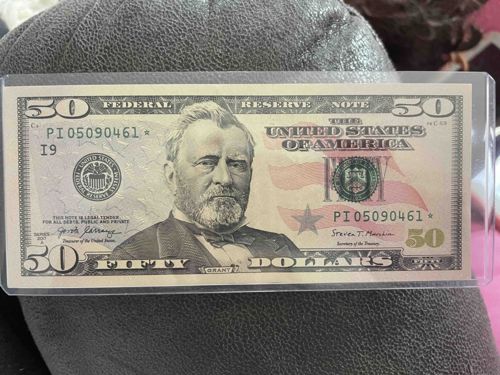
The item is a United States fifty-dollar bill, specifically a Federal Reserve Note, dated series 2017. The bill features a portrait of Ulysses S. Grant on the obverse, a common design element for this denomination. It is presented in what appears to be a clear, protective plastic sleeve or holder, indicating an intent for preservation or collection.
Key physical characteristics include the standard dimensions for U.S. paper currency. The dominant colors are green and black, with subtle security features integrated, such as a pinkish hue in the background of 'UNITED STATES OF AMERICA' and a holographic security ribbon. The serial number 'PI05090461*' is clearly visible on both the left and right sides of the obverse, accompanied by a 'star' suffix which indicates it is a replacement note, often sought after by collectors. The Federal Reserve Bank indicator 'I9' in the bottom left indicates it was issued by the Federal Reserve Bank of Minneapolis. The signatures of the Secretary of the Treasury, Steven T. Mnuchin, and the Treasurer of the United States, Jovita Carranza, are evident. The number '50' is prominently displayed in all four corners and below Grant's portrait. The overall condition appears excellent, with no visible folds, tears, or significant wear, suggesting it is either uncirculated or has seen very limited circulation. The crispness of the printing and absence of visible handling marks further supports a high-grade condition. The plastic holder itself shows no signs of damage affecting the note within.
AI Appraisal Report
Based on my visual examination of the provided image, this United States Fifty-Dollar Bill, Series 2017, with the serial number PI05090461*, appears to be in exceptional condition. The crispness of the printing, lack of visible folds, tears, or significant wear suggests it is likely uncirculated (UNC) or very close to it. The protective plastic sleeve has clearly played a role in maintaining its pristine state. All security features mentioned, such as the holographic security ribbon and the pinkish hue, are consistent with authentic 2017 series notes.
The key factor impacting its potential value beyond face value is the 'star' suffix in the serial number, indicating it is a replacement note. Replacement notes can be more desirable to collectors due to their slightly scarcer nature compared to standard circulation notes. The Federal Reserve Bank indicator 'I9' for Minneapolis is also noted. While star notes carry a premium, the 2017 series is relatively recent, and unless the serial number itself holds a special pattern (e.g., low serial, radar, repeater), the collectible premium is modest.
Market conditions for modern fifty-dollar star notes in uncirculated condition typically see them trade at a slight premium over face value. Comparables for similar high-grade 2017 series star notes generally range from face value up to 50% above face, depending on the specific serial number and the seller. A specific rare serial number (e.g., very low, radar, or solid) would significantly increase demand and rarity.
My primary limitation in this appraisal is the reliance on images alone. While the visual evidence strongly suggests authenticity and high grade, definitive authentication and precise grading (e.g., UNC-65 vs. UNC-68) would require in-person examination. This would allow for tactile inspection of paper quality, examination under various lighting conditions, and precise measurement of margins and color, which can affect the final numerical grade. Provenance documentation, while not usually available for individual banknotes, would add another layer of verification. Scientific testing (e.g., ink analysis) is generally reserved for significant discrepancies or extremely high-value items, which this note does not appear to be. Given the lack of a 'fancy' serial number, its value as a collectible is primarily driven by its uncirculated condition and star note designation.