AI estimate as of August 25, 2025 · verify with a professional before acting
AI-Generated · Verify before acting
Everything on this page is generated by AI for informational purposes only. AI can make mistakes — the AI may misidentify items or misattribute them (artist, maker, brand, designer, origin, era). This is not an official valuation and should not be used for insurance, sale, tax, estate, legal, or lending purposes — or any decision requiring a certified appraisal. It is not an authoritative claim about any person, brand, or rights holder — do not share or rely on it as a factual statement about a third party. Always consult qualified professionals before making financial decisions.
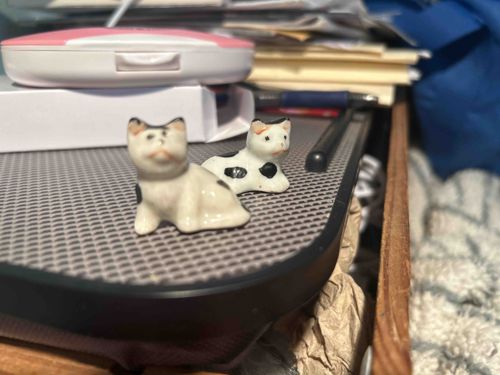
The image displays two small ceramic cat figurines, likely made of porcelain given their smooth, glazed appearance. Both figurines are predominantly white with hand-painted black and orange/brown markings, giving them a calico or tuxedo cat aesthetic. They appear to be fairly small, possibly miniature or thimble-sized, based on their scale relative to the surrounding objects. One cat is depicted in a seated or reclining pose, while the other is more upright, sitting with its front paws extended. The painting is somewhat simplistic, indicating they might be mass-produced decorative items rather than fine art ceramics. There are no visible chips, cracks, or significant wear, suggesting they are in good to very good condition. The glaze appears consistent and shows no signs of crazing. Due to the lack of clear maker's marks or distinguishing stylistic elements, it's difficult to pinpoint an exact manufacturing origin or date, but they likely date from the mid-20th century to the present, common for collectible animal figurines. The craftsmanship suggests a charming, somewhat whimsical quality, typical of miniature porcelain animal collectibles. They are unpainted on the underside according to the available views, which is common for figurines of this type.
AI Appraisal Report
Upon visual examination of the provided image, I assess these miniature ceramic cat figurines to be in good to very good condition. There are no readily apparent chips, cracks, or significant surface wear. The glaze appears intact and consistent, without visible crazing. The hand-painted black and orange/brown markings, giving them a calico or tuxedo aesthetic, are simplistic but charming.
Authenticity, based solely on images, is limited. These appear to be mass-produced decorative items, common from the mid-20th century onwards. Without maker's marks, provenance documentation, or in-person examination, I cannot definitively confirm their exact origin, manufacturer, or age. The lack of visible defects suggests they have been well-preserved or are relatively modern.
Market conditions for such common miniature ceramic animal figurines are generally steady but low. Comparables exist widely across online marketplaces and antique shops, typically selling in the low dollar range. Demand for generic miniature cat figurines is modest; they are typically impulse buys or collected as part of broader animal figurine sets. Rarity is not a factor here, as similar items were produced in high volumes.
Factors significantly impacting value involve material quality (porcelain vs. earthenware), manufacturer (if a known ceramic producer), age (true vintage vs. modern reproductions), and uniqueness of design or artist. For these specific items, without clear distinguishing features, the value remains primarily decorative.
For full authentication and a more precise valuation, an in-person examination would be crucial to assess the ceramic body, glaze quality, and search for any hidden marks. Provenance documentation could specify their origin and history. Scientific testing, like thermoluminescence dating, could establish age, though it would be cost-prohibitive for items of this likely value.