AI estimate as of October 11, 2025 · verify with a professional before acting
AI-Generated · Verify before acting
Everything on this page is generated by AI for informational purposes only. AI can make mistakes — the AI may misidentify items or misattribute them (artist, maker, brand, designer, origin, era). This is not an official valuation and should not be used for insurance, sale, tax, estate, legal, or lending purposes — or any decision requiring a certified appraisal. It is not an authoritative claim about any person, brand, or rights holder — do not share or rely on it as a factual statement about a third party. Always consult qualified professionals before making financial decisions.
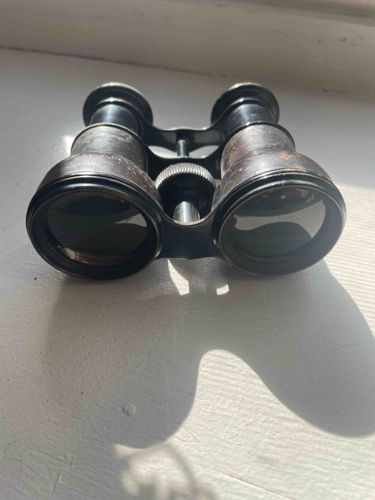
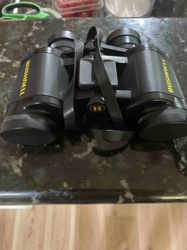
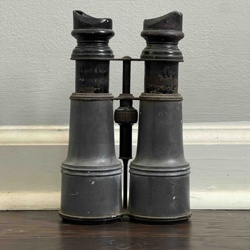
This item is a pair of vintage field binoculars, likely dating from the early to mid-20th century. Constructed primarily of black-painted or anodized metal, possibly brass or steel, the binoculars exhibit a classic porro prism design. The main body of the binoculars is a dark, matte black, which appears to have considerable wear, revealing a possibly metallic or darker base material underneath, hinting at extensive use over the years. The barrels where the objective lenses are housed show significant finish loss, appearing scratched and scuffed, with some discoloration or corrosion forming a reddish-brown patina in areas. The black rings around the objective lenses are sturdy and tightly fitted, indicating good construction. A central ridged focusing wheel, also black, is prominently visible, suggesting a central focus mechanism. The ocular lenses, though not clearly visible in sharp detail, appear to be securely set. The overall condition suggests a well-used but potentially still functional piece of optical equipment. There are no obvious maker's marks or signatures visible from this angle, which could be important for determining manufacturer and specific model. The craftsmanship appears to be robust and utilitarian, suitable for field use. The form factor is typical of binoculars from an era before more compact designs became prevalent, pointing to a period where optical performance and durability were prioritized.
AI Appraisal Report
Based on my visual examination of the provided image, this item is a pair of vintage field binoculars, consistent with early to mid-20th-century porro prism designs. The condition is fair to poor, showing significant wear, paint loss, scratches, and potential surface corrosion, particularly on the objective lens barrels. This wear suggests extensive use and indicates it has not been meticulously preserved. The robust, utilitarian construction is typical of the era, prioritizing durability over aesthetics. The presence of a central focusing wheel indicates a functional design.
Authenticity, as a vintage item, seems plausible based on the design and apparent material wear. However, without visible maker's marks or serial numbers, definitive authentication regarding manufacturer or specific model is impossible from images alone. An in-person inspection would be crucial to identify any hidden marks, assess lens clarity and collimation, and evaluate the mechanical function of the focus mechanism.
Market conditions for generic, unmarked vintage binoculars in this condition are generally modest. While there's a niche market for vintage optics, the lack of a known manufacturer (like Leitz, Zeiss, or Bausch & Lomb) significantly limits its appeal to serious collectors. Comparables on online marketplaces for similar unmarked, well-used vintage binoculars typically range from $20 to $100. Demand is low except for specific, rare, or military-issued models. This pair lacks any apparent rarity attributes. The primary factors impacting value negatively are the significant cosmetic wear and, critically, the absence of any identifying marks. An in-person examination, including checking for internal haze, fungus, or prism separation, and assessing the smoothness of the focus mechanism, would be needed to confirm functionality and refine the value.