AI estimate as of November 5, 2025 · verify with a professional before acting
AI-Generated · Verify before acting
Everything on this page is generated by AI for informational purposes only. AI can make mistakes — the AI may misidentify items or misattribute them (artist, maker, brand, designer, origin, era). This is not an official valuation and should not be used for insurance, sale, tax, estate, legal, or lending purposes — or any decision requiring a certified appraisal. It is not an authoritative claim about any person, brand, or rights holder — do not share or rely on it as a factual statement about a third party. Always consult qualified professionals before making financial decisions.
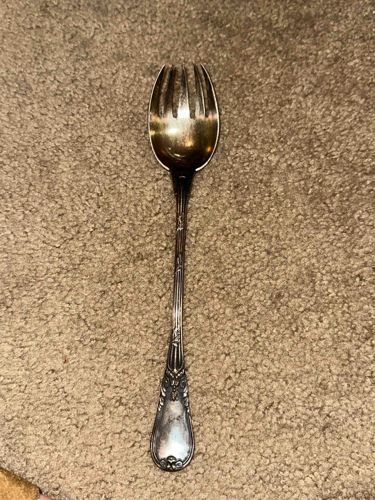
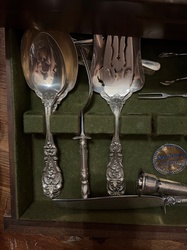
This item is an antique or vintage serving utensil, appearing to be a spork or a specialized serving fork, made from a silver-plated base metal. Its overall length is substantial, typical for a serving piece. The 'bowl' end of the utensil is rounded like a spoon but features four prominent tines, suggesting its use for both scooping and piercing, commonly found in serving forks for items like macaroni salad, olives, or fruit. The material has a distinct silver luster, though a noticeable tarnishing, particularly in the deeper crevices of the ornate handle and around the base of the tines, indicates its age and the nature of silver-plate. The handle is exquisitely decorated with a highly detailed, probably repoussé or stamped, floral and foliate (leaf) motif. This ornamentation extends from the base of the bowl down to the flared end of the handle, culminating in a small, stylized flower or crest. The central part of the handle features a more linear, possibly fluted or reeded, design framed by the ornate borders, adding to its elegant appearance. There are no immediately visible maker's marks or hallmarks in the provided image, which would typically be found on the back of the handle or neck. The condition shows visible wear consistent with age and use, including surface scratches and the aforementioned tarnishing. There are no obvious signs of significant damage like bends or breaks, suggesting it has been well-preserved despite its age. The craftsmanship suggests a manufacturing period likely spanning the late 19th to early 20th century, common for such elaborate silver-plated serving wares, possibly in the Victorian or Art Nouveau style due to the organic decorative elements. Its quality seems to be good, indicating a well-made piece intended for formal dining or serving.
AI Appraisal Report
Based on my visual examination of the provided image, this antique or vintage silver-plated serving spork/fork is in good condition for its age. Authenticity as a period piece from the late 19th to early 20th century, likely Victorian or early Art Nouveau, is suggested by the elaborate floral and foliate repoussé or stamped ornamentation and the typical form of such serving pieces. The visible tarnishing is consistent with silver-plate and age, not damage. Surface scratches are present, as expected with use.
Market conditions for silver-plated items, even ornate ones, are generally moderate. While the craftsmanship is good, solid sterling silver pieces command significantly higher prices. Comparables in the antique silver-plate market for similar serving utensils typically range from $20 to $75 depending on maker, pattern, and condition. The ornate handle design adds a decorative appeal, contributing positively to its value. Demand for such specific serving pieces is niche rather than broad, and while not excessively rare, countless similar patterns were produced by various manufacturers.
The primary factor impacting value is its silver-plated nature rather than solid silver. The absence of visible maker's marks or hallmarks, often present on the reverse, prevents identification of the specific manufacturer, which could potentially elevate value if it were a renowned producer. Without physical inspection, I cannot definitively confirm the base metal or the precise plating technique, nor detect any subtle repairs or alterations. An in-person examination would allow for tactile assessment of quality and definitive identification of any hallmarks. Provenance documentation would further solidify its history and authenticity. Scientific testing is typically not applied to such items unless there's a strong claim of precious metal or a rare alloy.