These notes were written by the person who submitted this item. Appraiser.AI has not verified them, and the AI's identification and estimate may rely on them.
AI Estimated Value
Not an official valuation
$150-300
AI estimate as of July 18, 2025 · verify with a professional before acting
AI-Generated · Verify before acting
Everything on this page is generated by AI for informational purposes only. AI can make mistakes — the AI may misidentify items or misattribute them (artist, maker, brand, designer, origin, era). This is not an official valuation and should not be used for insurance, sale, tax, estate, legal, or lending purposes — or any decision requiring a certified appraisal. It is not an authoritative claim about any person, brand, or rights holder — do not share or rely on it as a factual statement about a third party. Always consult qualified professionals before making financial decisions.
This analysis also relies on unverified notes provided by the user, which may be incomplete or inaccurate and could affect the result.
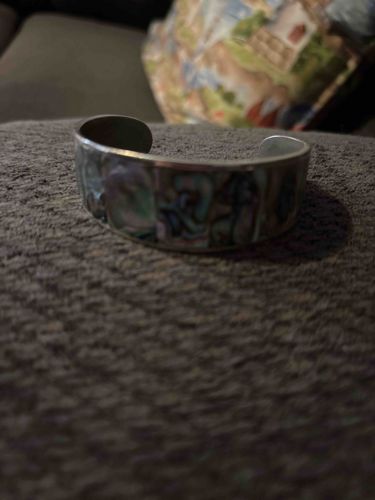
This item is an antique cuff bracelet. It appears to be constructed from a metal base, likely silver or a silver-plated alloy, given its somewhat tarnished, dulled metallic sheen, characteristic of age and exposure to air. The bracelet features a wide, open-back cuff design, allowing it to be slipped onto the wrist. The front surface of the bracelet is adorned with an inlay of iridescent material, most likely abalone or mother-of-pearl. The inlay is composed of numerous small, irregular, tessellated pieces fitted together to create a continuous mosaic pattern. These pieces exhibit a captivating play of color, shifting between greens, blues, purples, and grays depending on the light and viewing angle, showcasing the natural iridescence of the shell material. The edges of the cuff appear smoothly finished, suggesting good craftsmanship in shaping and polishing the metal. There is visible patina on the metal, particularly on the interior and edges, indicating its age. While no maker's marks or signatures are discernible from the provided images, the 'antique' context provided suggests it could date from the early to mid-20th century, a period when such shell inlay jewelry was popular, especially in areas with indigenous craftsmanship traditions (e.g., Mexico, southwestern USA). The craftsmanship, though not highly intricate in carving, demonstrates careful cutting and fitting of the shell pieces and a solid construction of the cuff, indicating a quality piece of costume or artisan jewelry from its era. The overall condition appears good for its age, with only expected signs of wear and patination.
AI Appraisal Report
Upon examining the provided image and description of this antique Abalone Inlay Cuff Bracelet, I've assessed its condition and potential value. The bracelet appears to be in good condition for its age, exhibiting expected patination on the metal base, which I believe is likely silver or a high-quality silver-plated alloy. The inlay, composed of tessellated abalone or mother-of-pearl pieces, shows no obvious signs of damage or missing sections, and its iridescence remains vibrant. The craftsmanship, particularly the careful fitting of the shell material, suggests a quality piece of artisan jewelry from the early to mid-20th century, a period when such designs were popular, especially from regions known for indigenous craftsmanship like Mexico or the American Southwest.  Market conditions for antique costume or artisan jewelry of this type are generally stable, with a consistent demand from collectors interested in vintage pieces. While not exceedingly rare, well-preserved examples with attractive inlay work are sought after. Factors positively impacting the value include its good condition, the appealing iridescent quality of the abalone, and its apparent age. However, its classification as costume or artisan jewelry, rather than fine jewelry, limits its top-end value. Without discernible maker's marks or a definitive attribution to a renowned artisan, the piece’s provenance is limited.  It is crucial to note the limitations of appraising solely from images. A definitive authenticity verification and accurate material identification (e.g., sterling silver vs. silver-plate) would require an in-person examination. This would allow for a thorough inspection of the metal for hallmarks, a tactile assessment of the construction, and potentially more precise identification of the shell material. Furthermore, any provenance documentation, if available, would significantly enhance certainty regarding its age and origin. Without these, the appraisal remains based on visual cues and historical context.