AI estimate as of November 2, 2025 · verify with a professional before acting
AI-Generated · Verify before acting
Everything on this page is generated by AI for informational purposes only. AI can make mistakes — the AI may misidentify items or misattribute them (artist, maker, brand, designer, origin, era). This is not an official valuation and should not be used for insurance, sale, tax, estate, legal, or lending purposes — or any decision requiring a certified appraisal. It is not an authoritative claim about any person, brand, or rights holder — do not share or rely on it as a factual statement about a third party. Always consult qualified professionals before making financial decisions.
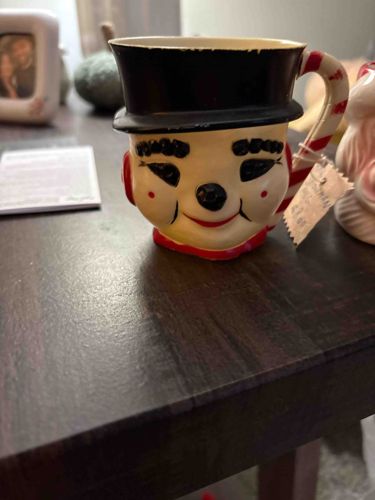
This item is a vintage ceramic figural mug, shaped like the head of a snowman wearing a black top hat. The mug features a primarily white body for the snowman's face, with hand-painted details. It has black closed eyes with prominent eyelashes, thick black eyebrows, a small black circular nose, and a wide red smiling mouth. Two red circular 'blush' spots are painted on its cheeks, and smaller red dots adorn the front of the ears/side of the face. The snowman wears a distinct black top hat that forms the upper rim of the mug. The handle of the mug is designed to resemble a red and white striped candy cane, looping from the side of the hat down to the base of the snowman's head. The base of the mug is accented with a red rim. The materials appear to be glazed ceramic or porcelain, typical for novelty mugs of the mid-20th century. The colors are vibrant but show some signs of wear, particularly along the rim of the black hat where the paint has chipped, revealing the lighter ceramic underneath. There's also a small area of paint loss on the red base. A white price tag is tied to the candy cane handle with a white string, indicating it might be a resale item. Given its style and the apparent wear, this mug likely dates from the mid-century period, possibly 1950s-1970s. The hand-painted details suggest individual craftsmanship, rather than mass-produced decals, adding to its vintage charm. The overall condition appears good for its age, with wear consistent with use and handling over decades. The specific manufacturer is not discernible from the image, but such items were commonly produced by various novelty ceramics companies.
AI Appraisal Report
I have visually examined this vintage ceramic figural snowman head mug. Its condition appears good for its age, exhibiting wear consistent with mid-century novelty ceramics. I note paint chipping along the black top hat rim and a small area of paint loss on the red base, which are common for glazed items of this era. The hand-painted details, such as the eyes, nose, mouth, and blush spots, suggest individual craftsmanship rather than decals, enhancing its vintage appeal. The candy cane handle is a charming design element.
Authenticity, based purely on visual inspection, points to a genuine vintage item from the mid-20th century (likely 1950s-1970s). The styling aligns with novelty holiday mugs produced during that period. Market conditions for such items are generally stable, driven by collectors of vintage holiday decor and novelty kitchenware. Comparables show similar novelty ceramic mugs from this era fetching modest prices. Demand is moderate, appealing to a niche market. Rarity is not a significant factor here, as many such varied designs were produced. The primary factors impacting value are its charming design, good condition relative to age, and its appeal as a collectible holiday item.
Limitations in authenticity verification from images alone include the inability to inspect for cracks, crazing, or repairs not visible. Without physical examination, I cannot assess the weight, tactile feel, or specific manufacturing marks, if any, that might be hidden. Provenance documentation, such as original sales receipts or manufacturer's stamps on the base, would aid in confirming its precise age and origin, but these are rarely available for such common items. Scientific testing is not typically warranted for items in this value range.