These notes were written by the person who submitted this item. Appraiser.AI has not verified them, and the AI's identification and estimate may rely on them.
AI Estimated Value
Not an official valuation
$30 - $50
AI estimate as of November 2, 2025 · verify with a professional before acting
AI-Generated · Verify before acting
Everything on this page is generated by AI for informational purposes only. AI can make mistakes — the AI may misidentify items or misattribute them (artist, maker, brand, designer, origin, era). This is not an official valuation and should not be used for insurance, sale, tax, estate, legal, or lending purposes — or any decision requiring a certified appraisal. It is not an authoritative claim about any person, brand, or rights holder — do not share or rely on it as a factual statement about a third party. Always consult qualified professionals before making financial decisions.
This analysis also relies on unverified notes provided by the user, which may be incomplete or inaccurate and could affect the result.
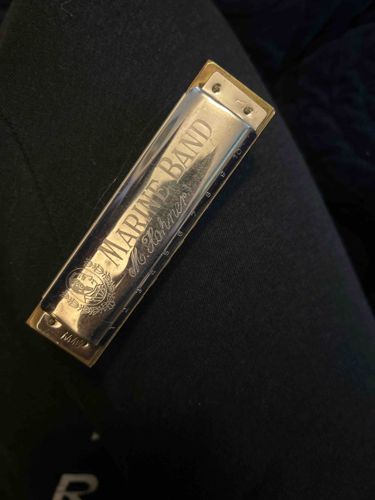
The item is a Hohner Marine Band harmonica, a diatonic harmonica commonly used in blues, folk, and rock music. It features shiny metallic cover plates, likely stainless steel or nickel-plated brass, which exhibit some minor surface scratches and smudges consistent with regular handling and use. The top cover plate is prominently engraved with the words 'MARINE BAND' in a bold, sans-serif font, and 'M. Hohner' in a more elegant, cursive script beneath it. To the left of 'MARINE BAND,' there is an embossed or engraved emblem, possibly a decorative crest or logo, though the fine details are not clearly discernible in the provided image. The comb, visible at the ends and through the gaps between the cover plates, appears to be made of a light-colored wood, typically pearwood for this model, and shows a warm, natural wood tone. The wood comb is attached to the cover plates with small, visible screws, suggesting a traditional construction. Along the lower edge of the top cover plate, numerical markers from '1' to '10' are visible, corresponding to the ten holes of the diatonic harmonica. The overall condition suggests a used but well-maintained instrument, with no major dents or damage, only typical wear expected from a musical instrument of this type. The design and markings indicate it is a standard Marine Band harmonica, a model that has been in production for over a century, making it difficult to pinpoint an exact age without more specific serial numbers or design features from different eras. Its construction and branding are indicative of a quality, mass-produced musical instrument.
AI Appraisal Report
Upon visual examination of the Hohner Marine Band harmonica, I assess it to be a standard, mass-produced model in used but well-maintained condition. The instrument presents with typical signs of use, such as minor surface scratches and smudges on the metallic cover plates, which is consistent with a played musical instrument. The wooden comb appears intact, and the engraved markings, including 'MARINE BAND' and 'M. Hohner,' are consistent with authentic Hohner branding. The overall construction appears genuine.
The Hohner Marine Band is one of the most popular and widely produced harmonicas in history. The market is saturated with both new and used examples, which keeps the resale value modest. Current market comparables for used, standard Marine Band harmonicas in similar condition typically fall within the $30 to $50 range. The value of this specific instrument is determined primarily by its functional condition as a playable instrument rather than any collectible rarity. Pre-war models or those associated with famous musicians can command higher prices, but this example shows no specific features to suggest such provenance.
A key factor limiting a higher valuation is its mass-produced nature and the lack of any unique or rare attributes. While the instrument appears authentic based on the provided images, a definitive verification of its age and originality is not possible without a physical inspection. An in-person examination would allow me to test the reeds for playability, inspect the comb for potential swelling or cracks, and look for subtle manufacturing details or serial numbers that could help date the instrument more precisely. Without provenance documentation linking it to a specific artist or historical period, its value remains that of a quality, functional used instrument.