AI estimate as of August 16, 2025 · verify with a professional before acting
AI-Generated · Verify before acting
Everything on this page is generated by AI for informational purposes only. AI can make mistakes — the AI may misidentify items or misattribute them (artist, maker, brand, designer, origin, era). This is not an official valuation and should not be used for insurance, sale, tax, estate, legal, or lending purposes — or any decision requiring a certified appraisal. It is not an authoritative claim about any person, brand, or rights holder — do not share or rely on it as a factual statement about a third party. Always consult qualified professionals before making financial decisions.
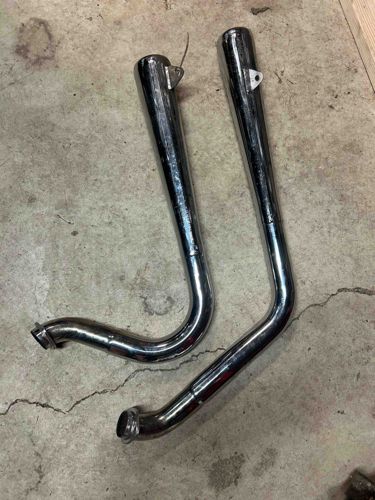
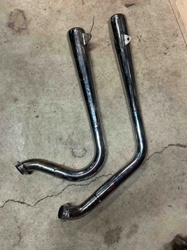
This item consists of a pair of chrome-plated motorcycle exhaust pipes, likely intended for a vintage or classic motorcycle given their simple, straight-through design. Each pipe features a polished, reflective chrome finish, which appears to be in fair condition with visible signs of wear. The pipes are of unequal length, suggesting they are designed for a specific motorcycle model, possibly a twin-cylinder engine where one header pipe is longer to reach the exhaust port. Both pipes exhibit a sharp, angular bend near one end, indicating where they would connect to the engine's exhaust manifold. The opposite ends are wider and appear to be the muffler sections, which taper slightly. Each muffler section has a welded mounting bracket, one triangular and one more rectangular, with a hole for attachment to the motorcycle frame.
Visible condition issues include scratches, scuffs, and areas of discoloration or surface rust beneath the chrome, particularly noticeable on the longer pipe. There are also some darker stains, possibly from heat or exhaust residue. The interior of the pipe openings appears to show carbon buildup, consistent with use. No obvious dents or structural damage are discernable from the image, but the chrome plating shows pitting and hazing in several areas, indicative of age and exposure to elements. The craftsmanship appears to be standard for mass-produced motorcycle components of their era. Without specific markings, it is challenging to ascertain the exact manufacturer or period, but the styling suggests a vintage aesthetic, possibly from the 1960s to 1980s.
AI Appraisal Report
Upon examining the provided image of these chrome motorcycle exhaust pipes, I assess them to be components likely from a vintage or classic motorcycle, possibly dating from the 1960s to 1980s, given their design and construction. Authenticity based solely on visual examination is limited; however, the styling aligns with numerous period exhausts. The pipes are of unequal length, suggesting fitment for a specific twin-cylinder engine configuration.
The condition is fair. The chrome plating exhibits considerable wear, including scratches, scuffs, areas of discoloration, and visible surface rust peeking through, particularly on the longer pipe. Pitting and hazing are also evident, consistent with age and exposure. Carbon buildup is visible internally, indicating prior use. Despite these cosmetic issues, no significant dents or structural damage are discernable, which is positive for functionality. The presence of welded mounting brackets suggests they are original or era-appropriate aftermarket parts.
Market conditions for vintage motorcycle exhaust pipes vary widely based on rarity, specific make/model fitment, and condition. Generic or common aftermarket pipes in this condition generally command lower prices. High demand exists for pipes for popular vintage models (e.g., certain Triumphs, BSAs, Harley-Davidsons, or Japanese classics), but without identifying marks or provenance, linking these to a specific desirable model is impossible. Rarity for such components is typically tied to the rarity of the motorcycle they belong to. The visible condition issues significantly impact value, as re-chroming is an expensive process often exceeding the value of common used pipes.
For full authenticity verification, an in-person examination would be crucial to check for manufacturer stamps, patent numbers, or part numbers that are not visible in the image. Physical inspection would also allow for precise measurements to confirm fitment to specific models, and a thorough assessment of the internal condition and structural integrity. Provenance documentation, such as service records or original purchase receipts, would also aid in definitively authenticating their origin and history.