These notes were written by the person who submitted this item. Appraiser.AI has not verified them, and the AI's identification and estimate may rely on them.
AI Estimated Value
Not an official valuation
$15-30
AI estimate as of October 11, 2025 · verify with a professional before acting
AI-Generated · Verify before acting
Everything on this page is generated by AI for informational purposes only. AI can make mistakes — the AI may misidentify items or misattribute them (artist, maker, brand, designer, origin, era). This is not an official valuation and should not be used for insurance, sale, tax, estate, legal, or lending purposes — or any decision requiring a certified appraisal. It is not an authoritative claim about any person, brand, or rights holder — do not share or rely on it as a factual statement about a third party. Always consult qualified professionals before making financial decisions.
This analysis also relies on unverified notes provided by the user, which may be incomplete or inaccurate and could affect the result.
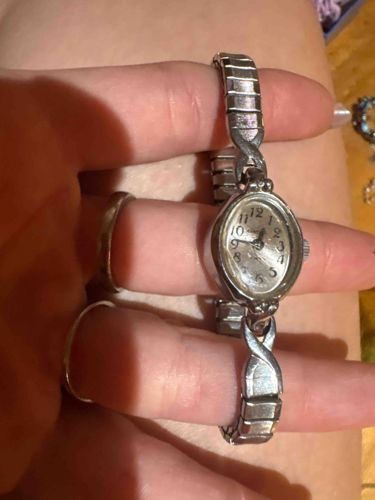
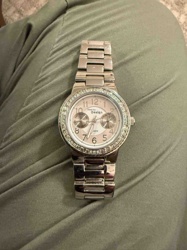
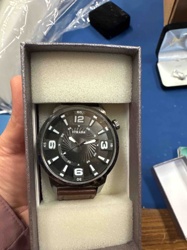
This item is a vintage ladies' wristwatch, characterized by its petite, oval-shaped watch head and a flexible, articulated stretch band. The watch case appears to be made of a silver-toned metal, possibly stainless steel or a plated base metal, given its somewhat dulled luster and visible wear. The dial is light-colored, potentially silver or white, featuring black Arabic numerals for hours 1 through 12, though some are partially obscured by glare or wear. The minute and hour hands are dark-toned and relatively slender. The crystal covering the dial is domed, showing some scratches and haziness consistent with age and use. Around the watch head, there are no obvious brand markings visible on the dial, with only 'QUARTZ' faintly discernible, indicating a quartz movement. The watch connects to the stretch band via distinctive, decorative 'X'-shaped or infinity-symbol-like links on both sides, which attach to the expanding metal segments of the band. The band itself is composed of numerous small, rectangular links with a brushed or satin finish, connected to allow for expansion and contraction to fit the wrist. The overall condition shows signs of use, including surface scratches on the metal components, slight discoloration or patina on the silver-toned metal, and potential wear on the watch crystal. There are no visible major repairs or significant damage, but the age and frequent use are evident. The style suggests a period from the late 20th century, likely 1980s to early 2000s, given the quartz movement and the design of the stretch band. The craftsmanship, while functional, appears to be typical of mass-produced fashion watches of that era, rather than high-end horology.
AI Appraisal Report
Based on my visual examination of the provided images, this 'Cardinal' branded vintage ladies' oval dial watch with a stretch band exhibits characteristics typical of a mass-produced fashion timepiece from the late 20th century, likely the 1980s to early 2000s, as suggested by the 'QUARTZ' designation and overall design. The silver-toned metal case, possibly plated, shows visible wear, including surface scratches and some dulling of the luster. The domed crystal has scratches and haziness, consistent with age and regular use. The dial, though light-colored with black Arabic numerals, lacks distinct branding beyond 'QUARTZ', which is common for lower-tier brands or unbranded quartz fashion watches. The stretch band, with its rectangular links and decorative 'X'-shaped attachments, is also indicative of this era's common women's watch styles. The condition, while showing use, does not reveal any significant damage or obvious repairs.
In terms of market conditions, vintage quartz fashion watches, especially those from lesser-known brands like 'Cardinal' (which was a Canadian brand known for affordable timepieces), generally have limited collector interest. Comparables in the market for similar mass-produced, non-precious metal quartz watches in used condition typically fetch modest prices. Demand for such items is low, and rarity is not a factor unless the piece possesses unique design elements or provenance, neither of which appears to be the case here. Factors impacting value negatively include the non-precious materials, the quartz movement (rather than mechanical), and the visible signs of wear.
It is important to note the limitations of authentication and precise valuation from images alone. A physical inspection would be crucial to confirm the material composition of the case and band (e.g., base metal plating vs. stainless steel), verify the functionality of the quartz movement, and assess the extent of crystal damage and overall wear more accurately. Without in-person examination, provenance documentation, or scientific testing, I cannot definitively confirm manufacturing origin or precise material content, which could slightly influence the appraisal. However, based on the visible evidence, these factors are unlikely to elevate its value significantly.