AI estimate as of November 10, 2025 · verify with a professional before acting
AI-Generated · Verify before acting
Everything on this page is generated by AI for informational purposes only. AI can make mistakes — the AI may misidentify items or misattribute them (artist, maker, brand, designer, origin, era). This is not an official valuation and should not be used for insurance, sale, tax, estate, legal, or lending purposes — or any decision requiring a certified appraisal. It is not an authoritative claim about any person, brand, or rights holder — do not share or rely on it as a factual statement about a third party. Always consult qualified professionals before making financial decisions.
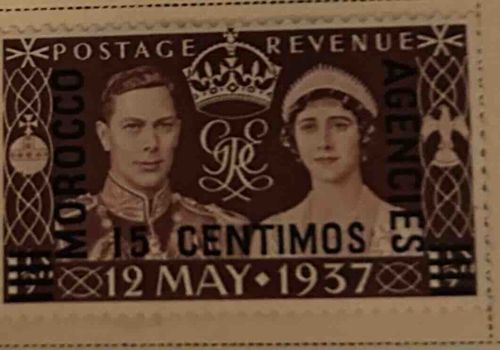
This is a vintage postage stamp, likely made of paper with an adhesive backing. The stamp features a dual portrait of King George VI and Queen Elizabeth of Great Britain. The overall color scheme is predominantly a rich brown or sepia tone, suggesting an older printing process. The design is horizontally oriented and appears to be in an unused or mint condition, with visible perforation edges on the top and bottom, and possibly sides (though not fully visible in the image). The monarch, George VI, is depicted on the left, facing slightly right, wearing what appears to be military attire with ornate epaulets and a collar. To the right is Queen Elizabeth, wearing a tiara or headpiece. Above the portraits, a crown is prominently displayed, centered between the two figures. To the right of the crown, the royal cypher 'GR' (George Rex) is visible in an ornate script. The top border of the stamp reads 'POSTAGE' on the left and 'REVENUE' on the right, with decorative elements flanking these texts. Along the left vertical edge, the word 'MOROCCO' is printed vertically, implying its origin or usage in Morocco. On the right vertical edge, 'AGENCIES' is printed vertically. The denomination '15 CENTIMOS' is clearly visible at the bottom of the portraits, with the date '12 MAY * 1937' below it. The style suggests a commemorative issue for the coronation of George VI in 1937. The printing appears crisp, indicating good quality and craftsmanship for its era. There are no obvious signs of wear, tears, creases, or major discoloration, suggesting it has been well-preserved.
AI Appraisal Report
Based on my visual examination of the provided image, this George VI and Queen Elizabeth (Morocco Agencies) postage stamp appears to be in superb, unused, or mint condition. The perforations are intact and well-defined, the printing is crisp, and there are no visible creases, tears, or significant discoloration. The design details, including the portraits, crown, royal cypher 'GR', and text, are all clear and sharp.
This stamp is part of the 1937 Coronation issue, specifically overprinted for use in Morocco Agencies. Factors like the '15 CENTIMOS' denomination and the '12 MAY * 1937' date are consistent with this release. The overall appearance suggests authenticity, though definitive verification without physical examination is limited. I would need to physically inspect the stamp to check for watermarks, paper type, gum condition, and potential hidden repairs or alterations. Microscopic analysis could confirm printing methods and ink consistency, further bolstering authenticity.
In terms of market conditions, stamps from the George VI era, especially commemorative issues in mint condition, generally maintain steady demand among Commonwealth philatelists. The 'Morocco Agencies' overprint adds a layer of specialization that can appeal to niche collectors, but this particular issue is not exceptionally rare. Comparables for this stamp in similar condition typically range from $50 to $75. The primary factors influencing its value are its exceptional condition and the specific overprint. While the demand is stable, its rarity is moderate.
For a conclusive appraisal, an in-person examination is crucial to assess gum condition (original gum is preferred), detect any hinging or thinning, and verify the absence of any hidden flaws not apparent in the image. Provenance documentation, such as expertization certificates, would also significantly enhance confidence in its authenticity and value.