These notes were written by the person who submitted this item. Appraiser.AI has not verified them, and the AI's identification and estimate may rely on them.
AI Estimated Value
Not an official valuation
$40-$120
AI estimate as of July 19, 2025 · verify with a professional before acting
AI-Generated · Verify before acting
Everything on this page is generated by AI for informational purposes only. AI can make mistakes — the AI may misidentify items or misattribute them (artist, maker, brand, designer, origin, era). This is not an official valuation and should not be used for insurance, sale, tax, estate, legal, or lending purposes — or any decision requiring a certified appraisal. It is not an authoritative claim about any person, brand, or rights holder — do not share or rely on it as a factual statement about a third party. Always consult qualified professionals before making financial decisions.
This analysis also relies on unverified notes provided by the user, which may be incomplete or inaccurate and could affect the result.
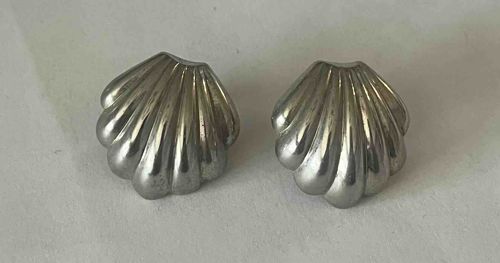
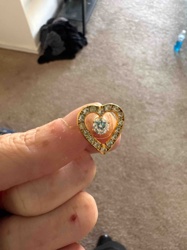
This is a pair of stud earrings, each designed in the shape of a scallop shell. The earrings appear to be crafted from a polished silver-toned metal, possibly sterling silver or a silver-plated base metal, given their luster and color. Each earring features a distinct ridged pattern, replicating the natural radiating grooves found on a scallop shell, which contributes to their three-dimensional and realistic appearance. The ridges are well-defined and run from a narrower top point, fanning out towards a wider, scalloped base, giving them a graceful and organic flow. The surface exhibits a bright, highly reflective finish, suggesting a good polish. There are no obvious signs of significant wear such as deep scratches, dents, or tarnishing, indicating they are either well-maintained or relatively new. No maker's marks or signatures are visible from this view, as the reverse side, where such details are typically located, is not shown. The overall craftsmanship appears to be of good quality, with smooth edges and consistent detailing across both pieces. Based on their design, they likely evoke a vintage or classic coastal aesthetic. Their size appears to be moderate, suitable for everyday wear without being overly statement-making. The absence of specific hallmarks makes an exact age determination difficult from the image alone, but the clean lines and polished finish are consistent with jewelry from the late 20th century onwards.
AI Appraisal Report
Upon visual examination of the provided image, I assess these Scallop Shell Stud Earrings to be in excellent condition. The surface shows a high polish with no visible scratches, dents, or tarnishing, which suggests they are either very well-maintained or relatively new. The craftsmanship appears good, with consistent ridged detailing replicating a natural scallop shell and smooth edges. Authenticity, based purely on visual inspection, is limited. The metal appears silver-toned, but without hallmarks or physical testing, I cannot definitively determine if it is sterling silver, another precious metal, or a plated base metal. This is a critical factor impacting value.
In terms of market conditions, scallop shell designs are perennially popular, especially within coastal or resort fashion themes. These earrings evoke a classic, possibly vintage, aesthetic. Comparables on the market for similar shell-themed stud earrings in fashion jewelry typically range from $20-$100 depending on material. If these were confirmed as sterling silver, the value would be on the higher end of this range or slightly above, given their aesthetic appeal and apparent quality. Demand for such charming, everyday wearable pieces is generally consistent. However, rarity is low; similar designs are widely produced.
Factors significantly impacting value are primarily the metal composition and the presence or absence of maker's marks, which would aid in authenticating origin and material. Without in-person examination, I cannot verify the metal's purity or identify any hidden hallmarks. For full authentication and accurate valuation, a physical inspection is essential to perform precious metal testing (e.g., acid test, XRF analysis) and locate any maker's marks or fineness stamps. Provenance documentation, if available, would also be invaluable.