These notes were written by the person who submitted this item. Appraiser.AI has not verified them, and the AI's identification and estimate may rely on them.
AI Estimated Value
Not an official valuation
$600 - $900
AI estimate as of July 14, 2025 · verify with a professional before acting
AI-Generated · Verify before acting
Everything on this page is generated by AI for informational purposes only. AI can make mistakes — the AI may misidentify items or misattribute them (artist, maker, brand, designer, origin, era). This is not an official valuation and should not be used for insurance, sale, tax, estate, legal, or lending purposes — or any decision requiring a certified appraisal. It is not an authoritative claim about any person, brand, or rights holder — do not share or rely on it as a factual statement about a third party. Always consult qualified professionals before making financial decisions.
This analysis also relies on unverified notes provided by the user, which may be incomplete or inaccurate and could affect the result.
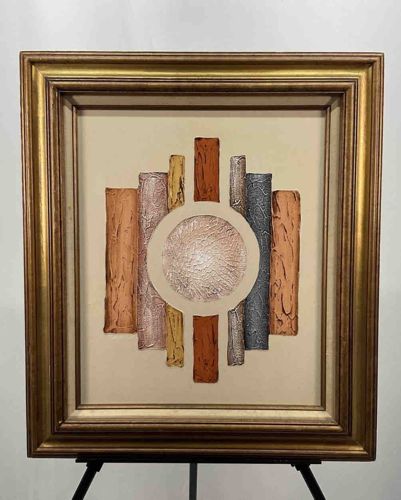
This is a framed abstract wall art piece, likely from the Mid-Century Modern to late 20th-century period. The artwork is characterized by its three-dimensional relief elements, providing texture and depth. The central motif is a raised circular form, appearing to be crafted from a light-colored material, possibly plaster or a composite, with a highly textured, almost crystalline or brain-like surface within its center. This circle is enclosed by a thinner, concentric raised ring. Extending from behind and around this central circle are several vertical rectangular or columnar elements of varying heights and widths. These elements display a range of earth-toned and metallic-like colors, including shades of bronze, copper, gold, and a muted silver or charcoal gray. Each vertical piece exhibits a textured, organic, bark-like, or possibly corrugated surface pattern, adding tactile interest. The colors appear to be painted or applied finishes, rather than the natural material colors themselves. All these relief elements are mounted on a flat, light beige or cream-colored background, creating a harmonious and unified composition. The entire artwork is housed within a substantial gold-colored wooden frame. The frame features a classic profile with multiple stepped and coved details, suggesting a traditional or ornate style that contrasts with the modern abstract subject. The gold finish of the frame shows a slight patina consistent with age, but no significant damage like chips or cracks are visible. The overall condition appears to be very good, with no obvious signs of wear, fading, or damage to the artwork itself, indicating careful preservation. The specific dimensions are provided as 32x29, implying inches, suggesting a medium to large-sized piece suitable for a prominent wall display. The craftsmanship appears to be of good quality, with attention to textural details and a cohesive color palette.
AI Appraisal Report
Upon examining the provided image and details, I assess this piece as a high-quality example of Mid-Century Modern abstract relief wall art, likely dating from the 1960s or 1970s. The artwork, measuring 32x29 inches, is in very good condition, with no visible fading, cracks, or significant damage to the relief elements or the background. The composition, featuring a textured central medallion and surrounding columnar forms in a palette of earth and metallic tones, is characteristic of the period's fascination with texture and abstract geometry. The substantial gold-leafed frame, while ornate, is period-appropriate and also appears well-preserved.
The current market for Mid-Century Modern decor is strong, and a piece of this size and quality is highly desirable. Its value is comparable to works by artists like Curtis Freiler and Jerry Fels of C. Jeré, although this piece appears to be unsigned. The primary factor limiting its value is the lack of an artist's signature or maker's mark. Full authentication without physical inspection is impossible. An in-person examination would be required to search for a signature, check for restoration, and identify the materials (e.g., plaster, resin, metal). Provenance documentation or artist attribution would significantly increase its value. Based on its aesthetic merit, scale, and condition as a decorative work of the era, the appraisal value is estimated based on the market for unattributed pieces of similar style and quality.