AI estimate as of October 15, 2025 · verify with a professional before acting
AI-Generated · Verify before acting
Everything on this page is generated by AI for informational purposes only. AI can make mistakes — the AI may misidentify items or misattribute them (artist, maker, brand, designer, origin, era). This is not an official valuation and should not be used for insurance, sale, tax, estate, legal, or lending purposes — or any decision requiring a certified appraisal. It is not an authoritative claim about any person, brand, or rights holder — do not share or rely on it as a factual statement about a third party. Always consult qualified professionals before making financial decisions.
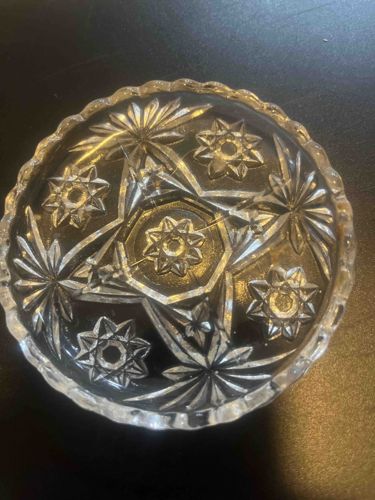
This is a small, round or circular dish made from clear, colorless pressed glass. Its most prominent physical characteristic is the intricate, geometric starburst pattern that dominates the interior surface, radiating outwards from a central hexagonal motif. The central hexagon is flanked by six smaller, eight-pointed starbursts, each with a small circular center. Between these smaller stars and extending towards the rim are larger, more complex star-like patterns, some appearing with a fan-like or multi-rayed design. The rim of the dish features a distinct ruffled or scalloped edge, adding a decorative flourish and suggesting a degree of refinement. The construction indicates it was likely made using a mold, characteristic of pressed glass manufacturing, where molten glass is pressed into a mold to create patterns and shapes. The overall color is transparent, showcasing the light-refracting qualities of the glass. While no explicit size is discernible, it appears to be a relatively shallow dish, potentially for condiments, trinkets, or as an ashtray. There are no visible maker's marks, signatures, or stamps in the provided images. The style is consistent with late 19th to mid-20th century pressed glass, often mimicking cut glass patterns but produced at a more affordable cost. The condition overall appears good, with no obvious chips, cracks, or significant damage. A slight patina or general wear might be present on the surface due to age and use, but this is not clearly visible in the provided images. The quality of craftsmanship, while mass-produced, is evident in the sharpness and consistency of the pressed patterns, indicative of a well-maintained mold.
AI Appraisal Report
Upon visual examination of the provided image, I assess this Pressed Glass Ruffled Edge Dish with Starburst Pattern to be in good overall condition. There are no readily apparent chips, cracks, or significant damage, which is a positive indicator for its value. The clarity of the glass and the sharpness of the pressed pattern suggest a well-preserved piece, likely from the late 19th to mid-20th century, consistent with the era of mass-produced pressed glass mimicking cut glass. Authenticity as a period pressed glass item appears high, given the characteristic molding and pattern. However, without a direct physical examination, I cannot definitively confirm the absence of subtle fleabites, internal bruising, or minor scratches that might affect its surface and light-refracting qualities.
Market conditions for common pressed glass pieces like this are generally modest. While decorative, they are not rare. Comparable items—similar ruffled-edge dishes with starburst or geometric patterns—typically retail in the $15-$35 range, depending on precise age, pattern intricacy, and actual condition. The lack of a specific maker's mark, while common for much pressed glass, does prevent attribution to a particular, potentially more collectible, manufacturer. Demand is steady among collectors of vintage decorative glassware, but it is not high volume or highly competitive, which keeps prices relatively stable and accessible.
Factors significantly impacting value include the excellent apparent condition and the attractive, well-defined starburst pattern. Its utility as a catch-all or decorative item also contributes to a baseline demand. Conversely, its mass-produced nature, lack of rarity, and absence of identifying marks limit its value.
It is crucial to note that this authenticity verification is based solely on visual inspection of the image. For full authentication and a more precise condition assessment, an in-person examination would be required to check for subtle flaws, weigh the item, examine the mold lines, and assess the glass quality under various lighting conditions. Provenance documentation, while unlikely for such a piece, would also offer definitive historical context.