AI estimate as of August 31, 2025 · verify with a professional before acting
AI-Generated · Verify before acting
Everything on this page is generated by AI for informational purposes only. AI can make mistakes — the AI may misidentify items or misattribute them (artist, maker, brand, designer, origin, era). This is not an official valuation and should not be used for insurance, sale, tax, estate, legal, or lending purposes — or any decision requiring a certified appraisal. It is not an authoritative claim about any person, brand, or rights holder — do not share or rely on it as a factual statement about a third party. Always consult qualified professionals before making financial decisions.
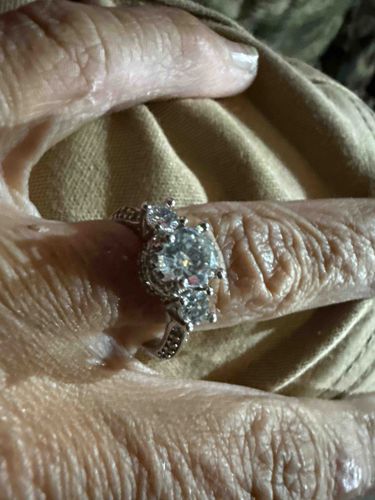
The item is a prominent three-stone ring, likely crafted from white gold, platinum, or a similar silver-toned metal, given its bright, reflective appearance. The main feature is a large, centrally set, brilliant-cut gemstone, likely a diamond or a high-quality simulants such as cubic zirconia or moissanite, given its exceptional clarity and sparkle. This central stone is flanked by two smaller brilliant-cut gemstones, one on either side, creating a classic three-stone design that often symbolizes past, present, and future. Surrounding the central stone, and possibly the side stones as well, appears to be a halo setting composed of numerous tiny pave-set or micro-pave-set stones, enhancing the overall brilliance and making the central stone appear larger. The ring's band is also adorned with smaller gemstones, likely set into the shoulders, adding to its luxurious aesthetic. The overall design suggests a contemporary or classic-contemporary style, emphasizing sparkle and significant stone coverage. The craftsmanship appears to be of good quality, with attention paid to the setting of multiple small stones. Visible condition issues are minimal from the image; the metal appears clean and bright, and the stones are clear and well-faceted without obvious chips or scratches. The setting looks secure. There are no discernible maker's marks or signatures visible in the image to determine specific manufacturing details or an exact age, but the style is popular in current jewelry trends, suggesting it could be a relatively modern piece.
AI Appraisal Report
Based on my visual examination of the provided image, I have assessed this three-stone ring with a halo setting. The condition appears to be excellent; the metal is bright and clean, and all visible stones are intact, clear, and well-faceted without obvious chips or abrasions. The setting work, particularly the pave-set halo and accent stones on the band, seems well executed and secure. Authenticity, however, is the primary limitation. While the stones exhibit significant brilliance and dispersion, it is impossible to definitively determine if they are natural diamonds or high-quality simulants (such as cubic zirconia or moissanite) from an image alone. The metal, while appearing platinum or white gold, would require testing for definitive identification.
Market conditions for such rings vary significantly based on stone type and metal. Assuming natural diamonds and white gold/platinum, comparable rings with similar carat weight (estimated 2-3ct total for main and side stones, plus accents) would command a higher value. If the stones are simulants, the value would be considerably lower, primarily reflecting the precious metal and craftsmanship. Demand for three-stone and halo designs is consistently strong due to their classic appeal and enhanced sparkle.
Factors significantly impacting value are the true nature of the gemstones and the specific metal alloy. Without in-person examination utilizing a diamond tester, a jeweler's loupe for inclusions, and specific gravity tests, the exact identity of the stones cannot be confirmed. Similarly, positive identification of the metal (e.g., 14K gold, 18K gold, platinum) would require acid or X-ray fluorescence testing. Provenance documentation, such as GIA or EGL diamond certificates, would provide critical authenticity and quality information. This appraisal range reflects the uncertainty between high-quality simulants in a precious metal and lower-grade natural diamonds in a precious metal setting.