AI estimate as of November 16, 2025 · verify with a professional before acting
AI-Generated · Verify before acting
Everything on this page is generated by AI for informational purposes only. AI can make mistakes — the AI may misidentify items or misattribute them (artist, maker, brand, designer, origin, era). This is not an official valuation and should not be used for insurance, sale, tax, estate, legal, or lending purposes — or any decision requiring a certified appraisal. It is not an authoritative claim about any person, brand, or rights holder — do not share or rely on it as a factual statement about a third party. Always consult qualified professionals before making financial decisions.
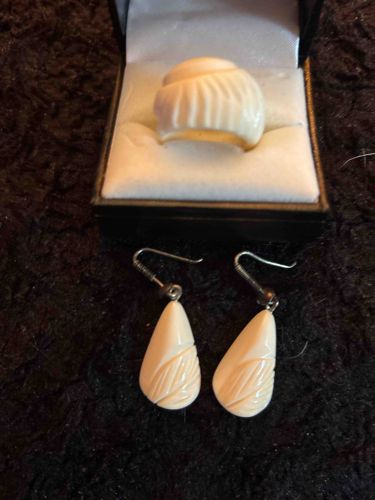
This lot consists of a matching jewelry set, including a distinctively carved ring and a pair of dangle earrings, likely crafted from bone or ivory. The ring features a domed, sculptural design suggestive of a shell or perhaps a stylized mushroom cap. It exhibits a smooth, polished surface with finely carved parallel grooves or flutes on its broader side, emanating from a central, raised spiral-like form. The color is an off-white to creamy beige, consistent with natural organic materials like bone or aged ivory. The band appears solid and integrated with the carved top. The earrings are teardrop or elongated ovular in shape, mirroring the material and color of the ring. Each earring features a curvilinear carved design, resembling overlapping leaves or feather-like textures, executed with precision. They are suspended from simple silver-tone shepherd's hook ear wires, which show some slight tarnishing or discoloration, indicating they might be sterling silver or a plated base metal. The overall condition appears good, with a visible patina that hints at age. There are no obvious chips, cracks, or significant damage, though closer inspection would be needed to confirm the absence of minute surface wear or repairs. The craftsmanship suggests a hand-carved origin, with attention to detail in the linear and curved patterns, indicating a certain level of artistry. The style points towards an ethnic or artisan-crafted aesthetic, possibly from the mid-20th century to contemporary, depending on the origin. The set has a cohesive aesthetic, indicating it was designed to be worn together. Given the color and texture, without further testing, it is challenging to definitively distinguish between bone and ivory, both of which were popular materials for such carvings.
AI Appraisal Report
This lot, comprising a carved ring and matching dangle earrings, presents as a charming, artisan-crafted jewelry set. Visually, the off-white to creamy beige material strongly suggests either bone or aged ivory. The ring's domed, sculptural design with its central spiral and finely carved flutes, along with the curvilinear 'leaf-like' patterns on the teardrop earrings, indicates careful hand-carving and a cohesive aesthetic. The overall condition appears good, with a visible patina consistent with age and use; no significant chips or cracks are immediately apparent from the image. The silver-tone shepherd's hook ear wires, showing some tarnishing, further support the vintage artisan feel.
Market conditions for carved organic jewelry are stable, with demand often driven by unique design and quality craftsmanship. Comparables typically fall within the $50-$150 range for well-preserved, hand-carved bone or costume ivory sets. Rarity is moderate; while not unique, finding a well-matched set in good condition adds to its appeal. The primary factor impacting value is the material itself. Distinguishing definitively between bone and ivory from images alone is impossible. Bone is less valuable than ivory, especially given current restrictions on ivory trade. To verify authenticity and material, in-person examination would be crucial to look for Schreger lines (characteristic of ivory), and potentially to conduct scientific testing. Provenance documentation would also greatly assist in confirming age and origin. Without definitive material identification, I am valuing this based on the assumption of either bone or non-restricted vintage ivory/material. If proven to be pre-ban CITES-compliant ivory, the value could be slightly higher, but trade restrictions would still apply.