AI Appraisal Estimate

AI-generated estimates · not official valuations

From the user

What was submitted

Photo and notes provided by the user — not generated by AI

Submitted item photo
Submitted photo · May 30, 2026

User's notes

No additional notes provided.

AI analysis below

AI appraisal

AI analysis & estimate

AI-Generated · Verify before acting

Everything below is generated by AI for informational purposes only. AI can make mistakes — the AI may misidentify items or misattribute them (artist, maker, brand, designer, origin, era). This is not an official valuation and should not be used for insurance, sale, tax, estate, legal, or lending purposes — or any decision requiring a certified appraisal. It is not an authoritative claim about any person, brand, or rights holder — do not share or rely on it as a factual statement about a third party. Always consult qualified professionals before making financial decisions.

Read the full disclaimer

AI Identification

·Not independently authenticated·Verify before acting

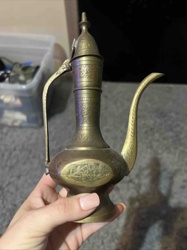
Indian Bidriware Hookah Base/Vase

Decorative Arts

AI Estimated Value

·Not an official valuation·Verify before acting

$400-600

As of May 30, 2026

AI Item Analysis

·AI can make mistakes·Verify before acting
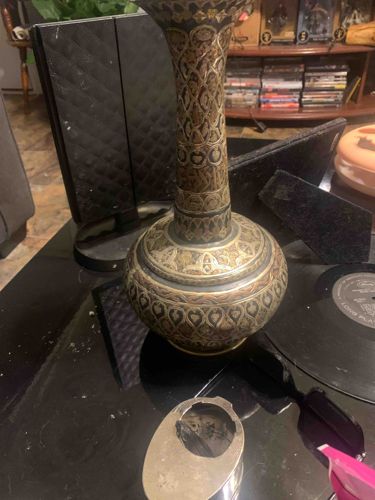
This item is an intricately decorated Indian Bidriware vessel, likely functioning as a hookah base or a decorative vase. It is characterized by its distinct dark metal body, possibly an alloy of zinc, inlaid with lighter-toned metal, likely silver or brass, using the Bidri technique. The physical form consists of a bulbous lower body that tapers gracefully into a long, slender neck. The entire surface is adorned with elaborate geometric and foliate patterns, showcasing intricate craftsmanship. The base of the bulbous section features a band of heart-like motifs, while the main body and neck are covered in a repeating, interlocking pattern that resembles stylized floral or arabesque designs. The dark background metal contrasts sharply with the shining inlays, creating a visually rich texture. The item exhibits signs of age and use, including a visible patina on both the dark metal and the inlaid elements, suggesting it is not a modern reproduction. There might be some minor surface wear consistent with handling over time, but no obvious chips, cracks, or significant damage are discernible from the provided images. The craftsmanship appears to be of good quality, with fine details in the inlay work. Given the style and technique, it likely dates from the late 19th to early 20th century, a common period for such decorative Bidriware objects. The overall aesthetic is distinctly traditional Indian, reflecting the rich artistic heritage of the region.
AI Appraisal Report

·AI can make mistakes·Verify before acting
Based on my visual examination of the provided images, this Indian Bidriware Hookah Base/Vase presents as a well-preserved example of traditional Indian decorative arts. The condition appears to be good; I observe a consistent patina across both the dark alloy body and the lighter metal inlays, which is indicative of age rather than damage and speaks to its authenticity as an older piece. There are no visible chips, cracks, or major deformations, only minor surface wear consistent with age and handling, which is expected for an item of this type. The intricate geometric and foliate patterns, with their sharp contrast between the dark underlying metal and the shining inlay, represent good quality Bidri craftsmanship. The tapering form from a bulbous base to a slender neck is a classic design for such vessels. Market conditions for Bidriware have seen steady interest, particularly for pieces with elaborate inlay and good preservation. Comparable items, typically dating from the late 19th to early 20th century, often sell within this price range, especially if they are decorative rather than functional or of historical significance. Demand for these pieces is driven by collectors of ethnographic art and those interested in traditional Indian decorative items. While not exceedingly rare, pieces in good condition with detailed artistry like this one are always sought after. The consistent patina and traditional design bolster its authenticity. Factors positively impacting value include the detailed craftsmanship and apparent good condition. It is crucial to note the limitations of an appraisal based solely on images. While the visual indicators are positive, a definitive authentication would require a physical inspection to assess the weight, tactile qualities of the metal, and the precision of the inlay work under magnification. Scientific testing could confirm the metal composition. Furthermore, any provenance documentation, even if anecdotal, would significantly enhance confidence in its authenticity and potentially its value. Without these in-person examinations, I cannot definitively confirm the age or the exact metals used, but the visual evidence strongly suggests an authentic, period Bidriware piece.

Get your items appraised

Instant estimates of your treasures with AI-powered appraisals

Browse More Appraisals