These notes were written by the person who submitted this item. Appraiser.AI has not verified them, and the AI's identification and estimate may rely on them.
AI Estimated Value
Not an official valuation
$250-400
AI estimate as of September 26, 2025 · verify with a professional before acting
AI-Generated · Verify before acting
Everything on this page is generated by AI for informational purposes only. AI can make mistakes — the AI may misidentify items or misattribute them (artist, maker, brand, designer, origin, era). This is not an official valuation and should not be used for insurance, sale, tax, estate, legal, or lending purposes — or any decision requiring a certified appraisal. It is not an authoritative claim about any person, brand, or rights holder — do not share or rely on it as a factual statement about a third party. Always consult qualified professionals before making financial decisions.
This analysis also relies on unverified notes provided by the user, which may be incomplete or inaccurate and could affect the result.
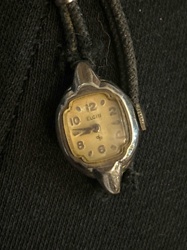
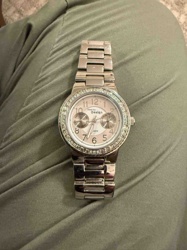
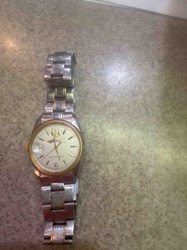
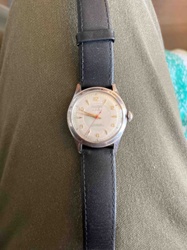
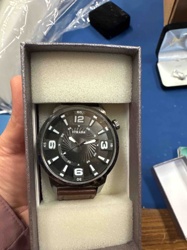
This is a vintage ladies' wristwatch from the brand Cyma, specifically bearing 'Cymaflex' on the dial, indicating a shock-protected movement. The watch features a small, round case, likely crafted from rose gold or a rose gold-plated base metal due to its warm, reddish-gold hue. The dial is a light, possibly cream or silver-tone, with thin, applied indices for hours and Arabic numerals at 12, 3, 6, and 9 o'clock. A gold-tone hour, minute, and seconds hand are visible. The crown, positioned at 3 o'clock, is textured for grip. Below the 12 o'clock marker, the 'Cyma' brand name is present, and 'Cymaflex' is printed above the 6 o'clock position. The watch is attached to an extendable, two-tone metal bracelet with a notable decorative lug design. The lugs connecting the watch case to the bracelet are stylized with ornate, possibly floral or scroll-like patterns, embellished with what appear to be small, clear stones (likely diamonds or rhinestones) set in white gold or platinum-toned metal. The rest of the bracelet consists of alternating segments, with the visible portions showcasing a combination of gold-tone links and possibly silver-tone or white gold-tone connections, forming an expandable mesh or ladder style. The overall condition appears good for its age, suggesting minimal heavy wear, though specific details like scratches on the crystal or case are not entirely discernible without closer inspection. This style suggests a period typically from the mid-20th century, likely 1940s-1960s, a common era for such delicate and decorative ladies' watches. The craftsmanship of the decorative lugs indicates a higher-end or attention-to-detail piece.
AI Appraisal Report
Based on my visual examination of the Cyma Cymaflex Ladies' Wristwatch, I assess its condition as good for its age, showing typical signs of vintage wear but no obvious heavy damage. The 'Cymaflex' on the dial is a good indicator of its authenticity as a Cyma timepiece, a reputable Swiss brand. The small round case appears to be rose gold-plated, given its warm hue and the common material choices for ladies’ watches of this style. The elegant applied indices and Arabic numerals on a light dial contribute to its classic appeal. The most distinctive feature is the ornate lug design, embellished with small, clear stones that are likely rhinestones rather than diamonds, given the expected market positioning for such a piece. The two-tone extendable bracelet also adds to its vintage charm.
Market conditions for vintage ladies' dress watches are generally stable but not exceptionally strong, unless they feature precious metals or significant complications. This piece, while aesthetically pleasing, likely falls into the collectible vintage category rather than high-value horology. Comparable watches in good, running condition from similar Swiss brands of the mid-20th century typically fetch within the $200-$500 range, depending on movement quality and case material. While the decorative lugs are unique, they don't necessarily push it into a higher bracket without confirmed precious materials.
Factors significantly impacting value include the potential for the case to be solid rose gold (which I cannot confirm visually), the actual material of the clear stones, and the watch's running condition. The rarity of this specific decorative lug design is moderate, as many brands offered similar embellishments during the era. For full authentication and a more precise valuation, an in-person examination is crucial. This would allow me to verify the case material, test the movement for functionality and accuracy, identify the stones set in the lugs, and scrutinize for hidden damage or repairs not visible in images. Provenance documentation, such as original boxes or papers, would also enhance its value and confirm authenticity.