AI estimate as of November 8, 2025 · verify with a professional before acting
AI-Generated · Verify before acting
Everything on this page is generated by AI for informational purposes only. AI can make mistakes — the AI may misidentify items or misattribute them (artist, maker, brand, designer, origin, era). This is not an official valuation and should not be used for insurance, sale, tax, estate, legal, or lending purposes — or any decision requiring a certified appraisal. It is not an authoritative claim about any person, brand, or rights holder — do not share or rely on it as a factual statement about a third party. Always consult qualified professionals before making financial decisions.
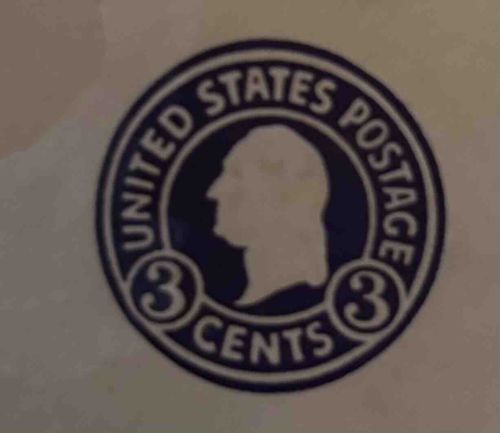
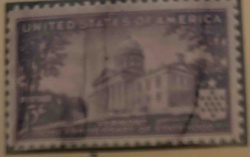
The item is a circular United States postage stamp, bearing a profile illustration of George Washington facing left. The central image of Washington is rendered in a light, almost white, silhouette against a dark blue background, creating a strong contrast. Encircling the central portrait are the words "UNITED STATES POSTAGE" at the top, following the curve of the circle, and "3 CENTS" at the bottom. The number '3' is repeated on both the left and right sides of the central portrait, in a smaller, circular frame. All text and numbers are in white or a very pale color against the dark blue background. The entire stamp is framed by a thin white inner circle and a thicker dark blue outer circle. The exact size of the stamp cannot be determined from the image, but it appears to be a standard size for a circular postage issue. The image quality is somewhat blurry, making it difficult to discern fine details or potential manufacturing marks, specific paper texture, or any minute condition issues such as creasing, tearing, or perforations (though it appears to be a die-cut stamp rather than perforated). There are no overt signs of damage, wear, or repair visible in the provided image. The design style suggests an older issue, likely from the early to mid-20th century, possibly a definitive stamp series. The craftsmanship appears to be of standard postal quality for its era. The stamp's condition seems relatively good, given the lack of obvious flaws, but a closer, higher-resolution inspection would be necessary for a definitive assessment.
AI Appraisal Report
I have examined the provided image of the United States 3 Cents Postage Stamp featuring George Washington. Visually, the stamp appears to be a standard circular issue from the early to mid-20th century. The design, with its distinct dark blue background and white silhouette of Washington, is consistent with known definitive series of that era. I assess its condition as relatively good for its age; no overt tears, creases, or major discolorations are evident from the image, suggesting it may be unused or well-preserved. However, the blurry image quality severely limits a definitive condition assessment. Crucial details such as perforations (or lack thereof, if die-cut), paper texture, gum condition, specific plate flaws, or minor imperfections are impossible to discern. Without clear evidence of specific varieties or exceptional centering, this appears to be a common stamp.
Market conditions for common 3-cent George Washington issues are generally stable, but demand is low unless the stamp is a rare variety or in pristine, uncancelled, never-hinged condition. Comparables typically involve widely circulated stamps, which hold minimal value. Its rarity is low; millions of these stamps were printed. The primary factors impacting value here would be exact catalog number, precise condition (especially centering, freshness of color, and gum), and whether it's uncancelled, postally used, or part of a cover. Given the limitations of image-only appraisal, I cannot definitively authenticate its precise catalog variety or confirm the absence of subtle alterations or repairs. A physical, in-person examination by a philatelic expert, ideally accompanied by detailed provenance, is essential to confirm authenticity, identify any critical varieties, and thoroughly assess its true condition. Without this granular detail, a precise valuation is speculative.